


What kind of driving work can you find in Sweden?
Truck driving, parcel delivery, bus routes, taxis and warehouse distribution all come up in Sweden’s job ads. But they’re not the same job with a different vehicle. A long-haul truck role might keep you away overnight, while a local delivery shift could mean dozens of stops before lunch.
Look at the licence requirements first. That’ll save you a lot of time.
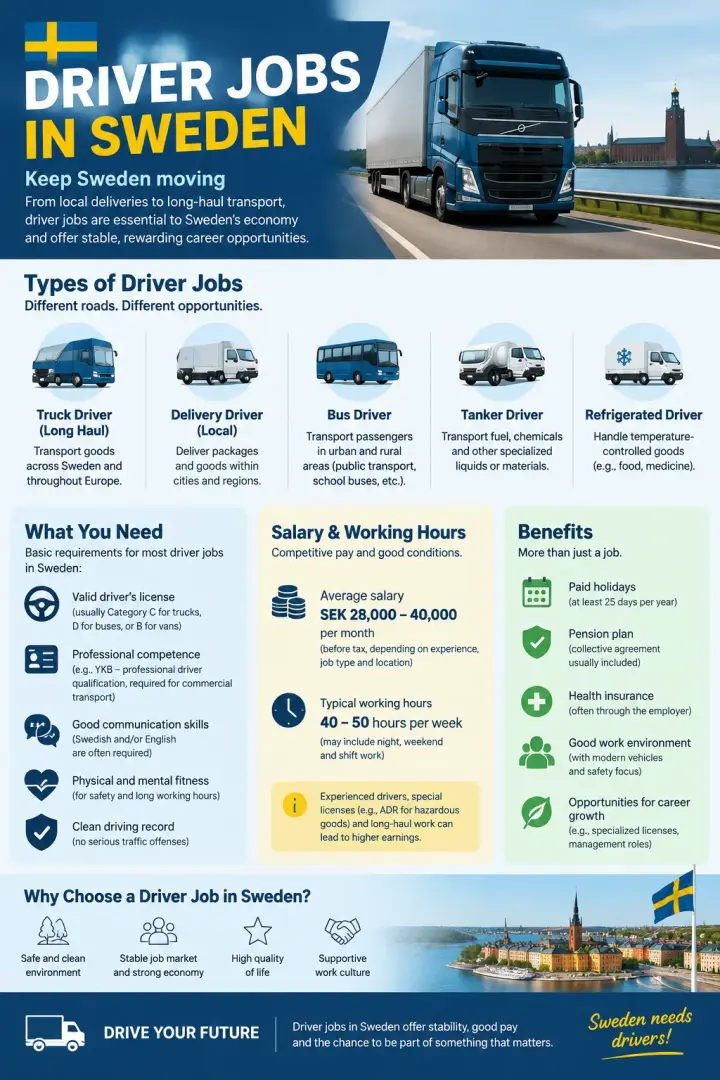
For a small delivery van, a category B licence may be enough. Heavy trucks usually call for category C or CE, and professional passenger or goods transport can require extra qualifications. Employers may also ask for experience with winter roads, customer service or loading equipment.
Swedish helps, especially when you’re speaking to passengers or customers. But some employers advertise in English, particularly for roles where the team already works in English. Check the ad instead of assuming either way.
Truck driver jobs: local routes or long-haul?
Sweden has a big road freight network, with drivers moving everything from food and timber to building supplies. You’ll see jobs around Stockholm, Gothenburg and Malmö, as well as near ports, warehouses and industrial areas farther north.
Some truck jobs are local. You might collect a vehicle early, deliver to several businesses and get home the same evening. Others involve longer routes across Sweden or into neighbouring countries, with nights away from home. Quite a difference if you’ve got a family or you’re arranging childcare.
For a heavy truck, employers commonly ask for a C licence. A CE licence covers certain truck-and-trailer combinations and can open up more jobs. Many professional goods drivers also need a valid Driver Certificate of Professional Competence, known in Sweden as yrkeskompetensbevis or YKB. There are exceptions, so check the rules for the work you’ll actually do.
One practical detail: if you’re carrying dangerous goods, you may need ADR training. Forklift experience can be handy too, though a truck licence doesn’t automatically qualify you to operate one.
What about the hours?
Ask whether the job involves nights, weekends or early starts. Some ads say “flexible hours” without spelling out what that means, and a 4 a.m. start isn’t everyone’s idea of flexibility.
Driving and rest-time rules apply to many commercial road transport jobs. Your employer should explain how shifts, breaks and any overnight trips are planned. If the answer’s vague, ask again.
Delivery driver jobs can be easier to enter
Parcel and food delivery roles often attract people who want to start driving professionally without a heavy vehicle licence. You may deliver packages to homes, bring groceries to customers or drive between local businesses. Some jobs involve a company van; others use a car, bike or scooter.
And there’s the small print. A B licence may be enough for the vehicle, but the employer can still set requirements for driving history, language, availability and the right to work in Sweden. Certain roles include lifting parcels or climbing stairs all day. That adds up.
Before accepting an offer, check who pays for fuel, parking, insurance and vehicle repairs. This matters even more if you’re expected to use your own car or work through a platform. Also ask whether you’re being hired as an employee or expected to run your own business. The difference affects things like tax, holiday pay and your income when work is quiet.
One more thing — a licence that’s valid for a short visit isn’t necessarily valid for long-term driving after you move. Check your own licence status before counting on a van job.
Bus and taxi jobs: you’ll be working with people
If you like driving but don’t want to spend the whole day alone, passenger transport might suit you. Bus drivers work on city routes, school services, regional lines and charter trips. Taxi drivers take local bookings, airport trips and other pre-arranged journeys.
For bus work, you’ll generally need the right category D licence and, for many professional roles, a valid YKB. Employers may run their own training programmes or help candidates work toward a licence, but don’t assume that’s included. Look for paid training details in the listing and ask what happens if you leave during the training period.
Taxi work has a separate requirement: a Swedish taxi driver’s licence, called taxiförarlegitimation. Transportstyrelsen, the Swedish Transport Agency, sets the rules and handles applications. You’ll need to meet its requirements and pass the relevant tests. A regular car licence on its own won’t cover it.
Passenger-facing jobs can call for stronger Swedish than some freight roles. Think about announcements, questions from travellers and what you’d do if something went wrong on the route. Ask the employer what language level they need rather than guessing from the job title.
Can you use your foreign driving licence in Sweden?
Sometimes, yes. The answer depends on where your licence was issued, whether it’s still valid and where you’re normally resident. Licences from EEA countries are generally recognised in Sweden, while different limits can apply to licences from outside the EEA once you become registered as a resident.
Don’t rely on a friend’s experience here. Two people can arrive with licences from different countries and face different rules.
Check Transportstyrelsen’s current guidance for your issuing country before applying. Find out whether your licence is valid for the category you need, whether it can be exchanged and whether you’ll need a Swedish test. For truck or bus work, check the status of your professional qualifications as well. A recognised driving licence and a valid YKB aren’t the same thing.
Keep copies of your licence and any training certificates ready. An employer may want to see the original documents later, but there’s no reason to send sensitive ID documents to an unverified stranger who’s contacted you on social media.
Do you need a work permit?
If you’re an EU or EEA citizen, you generally have the right to work in Sweden without a Swedish work permit. The rules can differ for family members and people with other immigration statuses, so check the details that apply to you.
Most people from outside the EU and EEA need a work permit to take a job in Sweden. In most cases, you must apply and receive a decision before travelling to start work, although exceptions exist. The job and employment terms need to meet the Swedish Migration Agency’s requirements, including the relevant salary threshold and conditions.
Those rules and thresholds can change. Check Migrationsverket, the Swedish Migration Agency, for the current figures and application steps instead of trusting an old recruitment post. And don’t pay someone just because they promise a “guaranteed visa”. A real employer can’t guarantee an immigration decision.
How much do drivers earn in Sweden?
There’s no single rate for driver jobs. Pay depends on the type of vehicle, experience, location, shift pattern and employer. A long-haul driver’s package can look different from a local courier’s, particularly when evening work, overtime or overnight allowances are involved.
Compare the basic wage, not just the biggest number in the ad. Is the figure before tax? Does it depend on overtime or bonuses? Ask how extra hours are paid, whether breaks are unpaid and what happens when a shift runs late.
Many Swedish workplaces follow collective agreements, known as kollektivavtal. These can set terms for pay, pensions, insurance and other conditions. Ask which agreement applies to the role and which union represents the workers. If there’s no agreement, get the terms in writing and read them carefully.
Questions worth asking before you sign
- Is the job permanent, fixed-term, hourly or through an agency?
- What’s the base pay before tax, and when is overtime paid?
- Who supplies the vehicle, work clothes and safety equipment?
- How many hours are guaranteed, if any?
- Will you be sleeping away from home, and who covers those costs?
- What training do you need to pay for yourself?
A friendly interview is nice. A clear contract matters more.
Where to find driver jobs in Sweden
Start with Platsbanken, the Swedish Public Employment Service’s job board. EURES is another useful place to look, especially if you’re applying from another European country. LinkedIn, Indeed and transport company career pages can turn up openings too.
Try searching in Swedish as well as English. Some useful terms are lastbilschaufför for truck driver, budbilsförare for delivery van driver and bussförare for bus driver. Add a city or region to narrow the results. “CE chaufför Göteborg”, for example, may bring up jobs that an English-only search misses.
Don’t overlook smaller towns. There can be work around distribution centres, mines, factories and timber operations outside the biggest cities. But check public transport and housing before applying; a depot on the edge of town is awkward if your shift starts before the first bus.
Make your application easy to check
Put your licence categories near the top of your CV, along with expiry dates and relevant qualifications such as YKB or ADR. Mention the kinds of vehicles you’ve driven, the routes you know and whether you have experience with loading, deliveries or passengers.
Keep it honest. If your Swedish is basic, say so. You can also mention English and any other languages you speak, plus whether you’re already allowed to work in Sweden or would need a permit. That gives the employer useful information straight away.
A short cover note can explain why the specific role fits you. For example, if you’re applying for a local grocery route, mention that you’re comfortable with early mornings and customer deliveries — if that’s true, of course. A generic note sent to fifty companies is easy to spot.
And check the recruiter before sharing documents or money. Look up the company, use contact details from its official website and be wary of an offer that arrives without a proper interview. If something feels off, pause.
Winter driving isn’t a footnote
Snow, ice and darkness can change a normal route fast, particularly in northern Sweden. Employers may expect you to understand winter driving, vehicle checks and how to adjust your speed and stopping distance. Some will offer training; others want previous experience.
Ask what support you’ll get and how the company handles unsafe conditions. You can check Transportstyrelsen’s current winter tyre rules for the vehicle and season involved. They’re not identical for every vehicle, and dates and conditions matter.
Finally, think about where you’ll live and how you’ll reach the depot. A job offer in Sweden sounds exciting, sure. But a reliable route to a 5 a.m. shift? That’s the detail you’ll appreciate on a dark January morning.