

What kind of driver job are you looking for?
Driving a city bus in Berlin feels pretty different from taking a truck across the country overnight. Both are driver jobs, sure, but the licence, hours and training can be miles apart.
In Germany, you’ll find openings for truck drivers, delivery drivers, bus drivers, taxi drivers and people who move goods around factories or warehouses. Some jobs keep you close to home. Others involve early starts, weekend shifts or several nights on the road.
And yes, there are opportunities for international applicants. The tricky part is checking whether your licence and right to work match the job before you apply.
Truck driver jobs in Germany
Truck drivers, often listed as Berufskraftfahrer or LKW-Fahrer, move everything from supermarket stock to building materials. You might drive a local delivery route, work between warehouses or take longer trips across Germany and neighbouring countries.
Most heavy truck jobs call for a category C or CE licence. Category C covers larger trucks, while CE includes trucks with a heavy trailer. For many paid truck driving jobs, you’ll also need a professional driver qualification, often shown as Code 95 on a licence or a separate driver qualification card.
Don’t assume a foreign truck licence automatically gives you everything an employer needs. The licence and the professional qualification are separate things, and both may need checking.
Long-distance work can mean nights away from home. Local routes may offer more regular evenings, though a 4 a.m. start isn’t unusual in transport. Check the actual route and shift pattern before saying yes.
What about driving hours?
Many truck and bus drivers must follow EU rules on driving time and rest. A common rule is that after 4.5 hours of driving, you need a break of at least 45 minutes, unless you’ve already taken a qualifying split break. Daily and weekly limits apply too, and some types of work have exceptions.
Drivers also use tachographs in many vehicles covered by these rules. Ask an employer how shifts, breaks and overnight stays are planned. It’s a fair question, not a fussy one.
Delivery driver jobs: a different sort of day
Parcel and food delivery jobs can be easier to enter than heavy truck work. For a delivery van with a maximum authorised mass of up to 3,500 kg, a category B licence is generally enough. Some employers also hire bicycle or e-bike couriers.
That doesn’t mean every job is easy. A parcel route might involve carrying boxes up several flights of stairs, finding parking and keeping track of dozens of addresses. On a rainy Tuesday? Less glamorous than it sounds.
Look closely at who employs you. Some delivery drivers work directly for a company; others work for a subcontractor or as self-employed couriers. Pay, insurance, equipment and holiday arrangements can be quite different.
Before accepting a role, ask whether the company supplies the van, pays for fuel and covers insurance. If you’re using your own vehicle, get the costs and responsibilities in writing.
Bus and taxi work
Bus drivers may work on city routes, school services, airport transfers or longer coach trips. Depending on the vehicle, you’ll generally need a category D or D1 licence, and many paid bus driving roles also require a professional qualification such as Code 95.
German can matter a lot here. Passengers may ask about stops, tickets or delays, and you’ll need to understand instructions at work. An employer can tell you what language level it expects for a particular role.
Taxi and some other passenger transport jobs come with their own rules. A regular car licence alone may not be enough; you may also need a passenger transport licence, often called a Personenbeförderungsschein or P-Schein. Local requirements and checks can vary, so ask the licensing authority and the employer what applies.
Can you use your foreign driving licence?
It depends on where the licence was issued and where you normally live. This is one of those details to sort out early, not after you’ve booked a flight.
Licences from the EU or EEA
A valid EU or EEA driving licence is generally recognised in Germany. But professional drivers still need to meet the rules for the vehicle and the paid work they’ll be doing. Truck and bus licence categories can also have limited validity, so check their expiry dates.
Licences from outside the EU or EEA
If you move your normal residence to Germany, a non-EU/EEA licence can generally be used for up to six months after establishing residence. There are exceptions and special rules, so check with your local driving licence office, called the Fahrerlaubnisbehörde.
After that, you’ll usually need a German licence to keep driving. Whether you can exchange your licence directly or must take theory and practical tests depends on the issuing country and licence category. Translation or other paperwork may be needed too.
One more thing — a licence that lets you drive a car won’t automatically qualify you for commercial truck or bus work. Ask the licensing office about your exact licence, and ask the employer about professional driver qualifications.
Do you need a visa to work as a driver?
EU and EEA citizens can generally work in Germany without a German work visa. Swiss citizens have their own arrangements and should check the relevant registration requirements.
If you’re from outside the EU, EEA or Switzerland, you’ll usually need a residence permit that allows you to work. A tourist visit or visa-free entry doesn’t automatically give you permission to take a job.
Germany has a route for certain professional drivers from non-EU countries, including truck and bus drivers, subject to specific conditions. In some cases, an employer can hire a person while they work toward the required German or EU/EEA licence and professional qualification. The rules are detailed, though, and the job and permit have to meet the relevant requirements.
Start with the official Make it in Germany website and the German embassy or consulate responsible for your application. And ask any prospective employer exactly what support they offer with licences, training and paperwork. Don’t pay someone who promises a guaranteed visa.
How much do driver jobs in Germany pay?
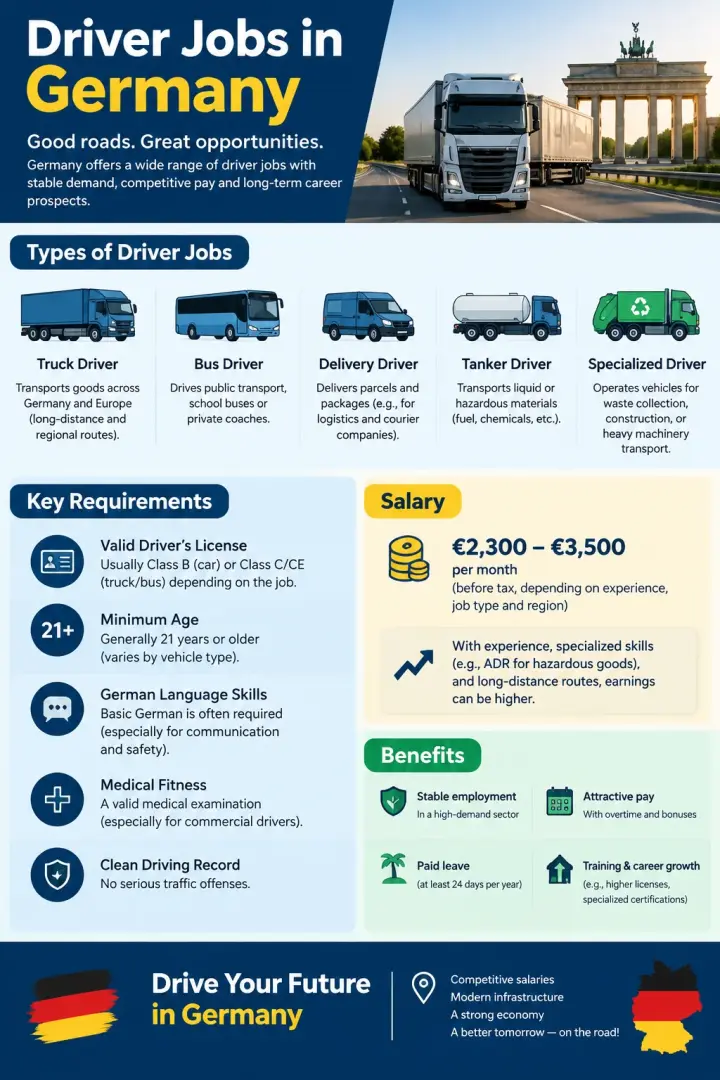
Pay varies a lot. A local van route, a long-distance truck job and a city bus position can have different basic rates, allowances and working hours. Experience, region, collective agreements and the employer all make a difference.
Compare offers using the gross amount: that’s pay before tax and social insurance deductions. Your take-home pay depends on your circumstances, including your tax situation and health insurance.
When you see a monthly figure, check how many hours it covers. A bigger number isn’t necessarily a better deal if it includes regular overtime or allowances that aren’t guaranteed.
- Is the basic pay hourly or monthly, and how many hours are expected?
- Are overtime, night shifts, Sundays or public holidays paid separately?
- Will you receive any travel or overnight allowances?
- Who pays for required training, medical checks and licence-related costs?
- Are accommodation or transport costs deducted from your pay?
Employees are generally entitled to Germany’s statutory minimum wage, with some exceptions, and a higher rate may apply under an agreement or contract. Check the current rate when you apply — it can change.
Where to find driver jobs in Germany
The German Federal Employment Agency’s job portal is a useful place to start. EURES also lists jobs and offers information for people moving within Europe. For international applicants, Make it in Germany has a job listings section and guidance on working in the country.
Company career pages are worth a look too. Search transport firms, bus operators, supermarket logistics teams and parcel delivery companies in the area where you want to live.
Try a few German search terms, even if you’re applying in English:
- LKW-Fahrer — truck driver
- Berufskraftfahrer — professional driver
- Auslieferungsfahrer or Fahrer für Paketzustellung — delivery driver or parcel delivery driver
- Busfahrer — bus driver
- Fahrer Klasse CE — driver with a CE licence
Add a city or region to narrow things down. “LKW-Fahrer Hamburg” will bring up more useful results than a search for every truck job in the country. Usually.
Getting your application ready
A clear CV is enough to start with. Include the licence categories you hold, their issuing country and expiry dates, plus any professional driver qualification. Mention the vehicles you’ve driven and the kind of routes you know — local deliveries, for example, or refrigerated transport.
For truck and bus roles, employers may ask about your driver qualification card, tachograph experience or training records. Keep copies handy. If a document isn’t in German, ask whether a translation is needed before paying for one.
Be honest about your German skills. Some warehouse and delivery teams work with people who speak several languages, but you’ll still need to understand safety instructions and do the job properly. Don’t claim you’re fluent if you’re not.
Check the offer before you move
A genuine job offer should tell you who your employer is, where you’ll work, what you’ll earn and what the job involves. Ask for the contract and read it carefully before making travel or housing plans.
Watch out for recruiters who ask for large upfront fees, won’t give you a company address or promise a work permit without checking your documents. If something feels off, contact the company using the details on its official website — not just the number in a message.
Employees in Germany generally have rights to paid holiday, sick pay under certain conditions and social insurance. Self-employed drivers have different arrangements, so check your status rather than relying on the job title.
And if accommodation is offered, ask for the address, rent, room-sharing arrangements and notice terms. A job that looks good on paper can feel very different when six people are sharing a room.