
What kind of driver job are you looking for?
Driving a city bus in Oslo is a different day’s work from hauling fish across northern Norway. Both are driver jobs, sure, but the licences, hours and language skills can be miles apart.
Start with the vehicle you’re qualified to drive. Then check whether your licence is valid in Norway and whether you have the right to work there. Those two details can save you a lot of time before you start sending applications.
And don’t rule out smaller towns. Transport companies, farms, hotels and local delivery firms all need drivers, not just employers in Oslo and Bergen.
Driver jobs you’ll find in Norway
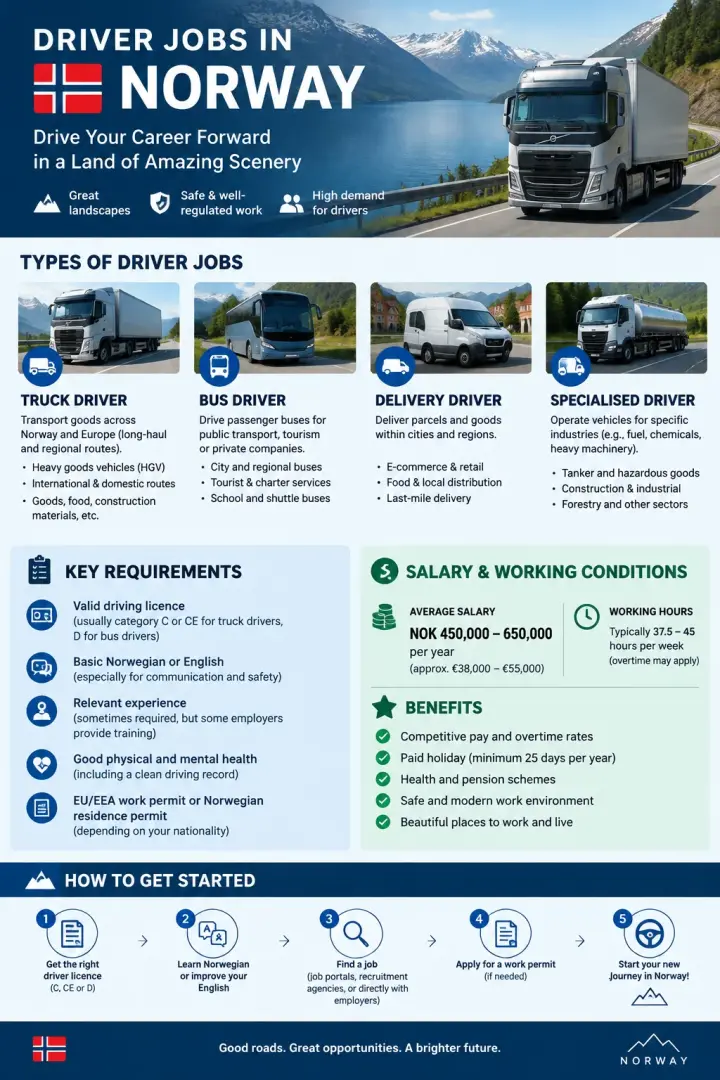
Truck and heavy goods drivers
Truck drivers move everything from supermarket stock to construction materials and seafood. Some routes are local, so you’re home most nights. Others involve long distances, overnight stops and mountain roads that demand a bit more patience in winter.
For a heavy truck, you’ll generally need a category C licence. A category CE licence covers a heavy truck with a heavy trailer. Category C1 covers certain smaller trucks between 3.5 and 7.5 tonnes, while C1E covers qualifying vehicle and trailer combinations.
Look closely at the advert before applying. A company might ask for experience with refrigerated goods, a crane, hazardous materials or a particular trailer. Hazardous goods work can require an ADR certificate too.
Bus and coach driving
Bus jobs include city routes, school transport, airport services and longer coach trips. Category D is generally needed for buses carrying more than eight passengers in addition to the driver. D1 covers certain smaller buses.
There’s a public-facing side to this work that’s easy to underestimate. Passengers ask questions, tickets go wrong, and someone’s always running for the stop. Many employers expect Norwegian because you’ll need to communicate clearly, though the level varies by job.
For passenger transport, check whether you also need a passenger-carrying driving permit, known as a kjøreseddel. It’s separate from your driving licence.
Delivery van and courier jobs
Parcel delivery can be a good place to look if you have a category B licence and want local work. Jobs range from grocery deliveries and pharmacy runs to packages for homes and offices.
Don’t assume it’s all driving, though. You might be lifting parcels, finding addresses in apartment blocks and working early mornings or evenings. In December? Things can get busy.
Some roles are direct employment. Others use contractors or self-employed drivers, so read the terms carefully before agreeing to provide your own vehicle.
Taxi and private hire
Taxi work can offer varied shifts and plenty of time on the road. You’ll generally need a valid passenger-carrying permit, and there are requirements relating to your licence, health and suitability. Check the current rules with the Norwegian authorities before paying for training or applying.
If you plan to run your own taxi business, that’s a separate matter from being hired as a driver. The business needs the proper operating licence, and there are costs to think about: insurance, equipment, vehicle finance and dispatch fees, for starters.
Can you use your driving licence in Norway?
That depends on where it was issued, what categories you hold and how long you’ll be living in Norway. Check the Norwegian Public Roads Administration, Statens vegvesen, for the rules that apply to your licence.
Licences issued in EU and EEA countries are generally recognised in Norway, provided they’re valid. There can still be rules around renewal, medical requirements and professional driving qualifications. A valid car licence doesn’t automatically make you eligible to drive a bus for work.
For licences issued outside the EU and EEA, the rules differ by country. You may be able to use your licence for a limited time, exchange it under certain conditions or need further testing. Don’t rely on a friend’s experience from another country — check your own situation with Statens vegvesen.
Keep your licence, identification and any qualification documents handy when applying. If your documents aren’t in English or Norwegian, ask the employer or relevant authority whether a translation is needed.
What’s Code 95?
Many professional truck and bus drivers need proof of professional driver competence, often shown as Code 95. The requirement applies to qualifying commercial driving and involves initial training or recognition of an existing qualification, plus periodic training. Some driving activities are exempt.
Already have Code 95 from an EU or EEA country? Check whether your qualification can be recognised and how it should be documented in Norway. If you don’t have it, ask training providers about the course, cost and timing before accepting a job that requires it.
Do you need a visa or work permit?
If you’re an EU or EEA citizen, you generally have the right to work in Norway, though registration rules apply when you stay longer than three months. You’ll still need to sort out practical things like tax and identification.
If you’re from outside the EU and EEA, you’ll generally need a residence permit that allows you to work. The Norwegian Directorate of Immigration, UDI, sets out the current options and conditions.
Here’s the thing: a job offer alone doesn’t mean you’ll qualify for a permit. For a skilled worker permit, your qualifications and the job itself must meet UDI’s requirements. Some driving jobs may qualify in particular circumstances; others won’t. Check the exact route before spending money on an application or making travel plans.
You generally can’t start working until your permit is granted, unless you’ve received permission for an early employment start. Ask UDI or the police if you’re unsure. And be wary of anyone promising a guaranteed visa in exchange for a large fee.
How much do drivers earn in Norway?
There isn’t one useful salary figure for every driver job. Pay depends on the type of vehicle, experience, shifts, employer and location. A local van job and a long-distance truck job can come with very different hours and allowances.
Norway doesn’t have one general minimum wage covering every occupation. Some sectors have legally required minimum rates, including certain road freight transport work, while other jobs may be covered by collective agreements. The Norwegian Labour Inspection Authority, Arbeidstilsynet, publishes current rules and rates.
When you compare offers, ask for the hourly rate or monthly salary in writing. Also ask how overtime, night work, weekends and time away from home are paid. A big monthly number can look less exciting when it depends on a lot of extra hours.
- Is the pay quoted before tax?
- Are loading, waiting time and vehicle checks counted as working time?
- Who pays for fuel, tolls, ferries and overnight accommodation?
- Is holiday pay included in the figure or paid separately?
- Will you be an employee or an independent contractor?
Get a written employment contract. If housing is offered, check the rent and any deductions too. A room near the depot sounds convenient until you find out what it costs.
Where to find driver jobs in Norway
Start with NAV’s job listings and FINN Jobb. Company websites are worth checking as well, especially for bus operators, logistics firms and supermarket delivery services. Recruitment agencies also advertise driving roles.
Search in Norwegian as well as English. It’ll open up more listings, even if you need a translation tool for the first read.
- “Sjåfør” for driver
- “Lastebilsjåfør” for truck driver
- “Bussjåfør” for bus driver
- “Varebilsjåfør” for van driver
- “Budbilsjåfør” for courier or delivery driver
- “Drosjesjåfør” for taxi driver
Add a place name or licence category to narrow the search. “Lastebilsjåfør CE Bergen” is more useful than scrolling through every transport vacancy in the country. You can also try “engelsk” if you’re looking for an English-speaking workplace, but don’t expect every such job to say so in the title.
Set up alerts, then check them regularly. Some employers need a driver quickly, particularly for seasonal work or holiday cover.
Do you need to speak Norwegian?
Not always. Some freight and warehouse teams work in English, especially where drivers come from different countries. But Norwegian can make a real difference, and customer-facing jobs often ask for it.
Bus and taxi drivers need to understand passengers and respond to everyday problems. Delivery drivers may need to call customers, read instructions or deal with a tricky entrance (there’s always one). Even a little Norwegian helps.
Be honest about your level on your CV. If an advert asks for conversational Norwegian and you’re still learning the basics, you can ask the employer whether English is accepted rather than guessing.
Getting your application ready
Keep your CV clear and practical. Put your licence categories near the top, along with Code 95 or other certificates if they apply. Employers shouldn’t have to search through three pages to find out whether you can drive the vehicle.
Include the types of vehicles you’ve driven, how long you’ve driven them and the work you did. A detail like “regional refrigerated deliveries with a CE combination” tells an employer more than “experienced driver”. Mention relevant safety training, languages and your right to work in Norway as well.
For references, ask a former manager or transport coordinator before sharing their details. And check the application language: an English CV may be fine, but a Norwegian advert might ask for an application in Norwegian.
Driving conditions aren’t the same everywhere
A route through central Oslo won’t prepare you for every road in northern Norway. Weather, darkness, narrow roads and ferry schedules can change the shape of a shift. Mountain crossings may close or operate with convoy driving during severe weather.
Winter driving deserves respect. Rules on tyres and chains depend on the vehicle, season and conditions, and heavy vehicles have specific requirements. Check Statens vegvesen for the current rules and ask the employer what equipment and training they provide.
Rest matters too. Professional drivers may be subject to driving-time and rest-period rules, including tachograph requirements. Don’t accept pressure to skip breaks or falsify records just to finish a route.
Before you accept an offer
Read the contract slowly. Check the employer’s name, workplace, hours, notice period and pay. Ask who’s responsible for the vehicle and what happens if a shift is cancelled or a delivery runs late.
You’ll also need to arrange your tax affairs with the Norwegian Tax Administration, Skatteetaten. That usually means getting a tax deduction card and the identification number appropriate to your situation. Without the right tax card, an employer may have to withhold more tax from your wages.
One last check — if someone asks you to pay upfront for a job, verify the company independently and contact it using details you’ve found yourself. A genuine vacancy should come with clear terms, not just a message promising work and asking for your passport and bank details.