
What kind of driving work can you find?
Driver jobs in the Netherlands cover a lot more than long-distance trucking. You could be dropping parcels around Utrecht, delivering groceries in Rotterdam, driving a bus in Eindhoven, or taking a loaded truck across the border into Germany.
Some jobs get you home every evening. Others involve early starts, night shifts, or a few days away. So before you apply for everything with “driver” in the title, think about what kind of week you actually want.
Delivery driver jobs
Parcel and grocery delivery are common starting points if you’ve got a category B driving licence. You’ll usually drive a van, follow a route on an app, load or check your orders, and deal with customers along the way.
Sounds straightforward? Some routes are busy, and parking in Dutch city centres can be a headache. Look for details about the number of stops, weekend work, and whether you’ll be lifting heavy packages.
Restaurant delivery is another option, though those jobs may involve a scooter or bicycle rather than a car. Check what vehicle you’ll use and whether the company provides it.
Truck driver jobs
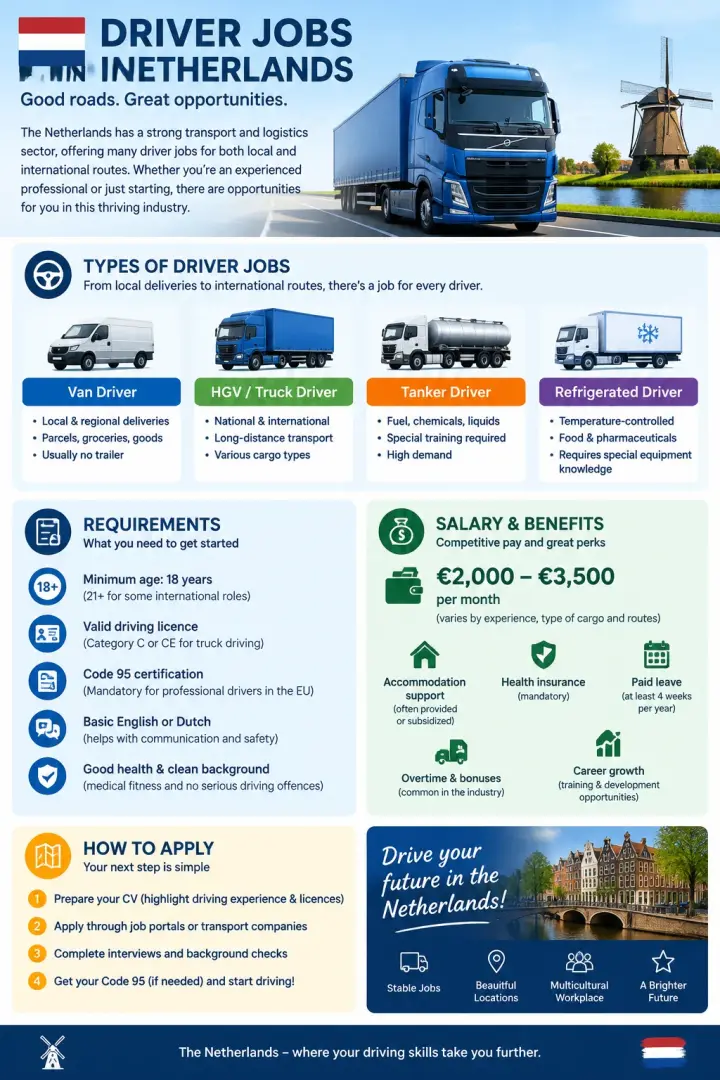
Truck drivers work in supermarket distribution, construction, container transport, waste collection, and international freight. A category C licence covers trucks over 3,500 kg, while CE is generally needed when you’re pulling a heavier trailer.
Many professional truck driving roles also require Code 95, a professional qualification recorded on your licence or another accepted document. There are exceptions, but don’t assume your job will qualify for one. Ask the employer what’s needed for the exact role.
And there’s a big difference between delivering to shops in the Netherlands and spending the week driving through several countries. Same industry, very different lifestyle.
Bus, coach, and passenger driving
Bus and coach jobs can suit drivers who like regular contact with people. Public transport operators, tour companies, and private coach firms all hire drivers, but the licence and training requirements are different from those for a van.
You’ll generally need a category D licence for a bus, plus Code 95 for most professional passenger transport. Some employers offer training routes for new drivers. Ask whether they’ll pay for the training and what happens if you leave the job early.
Taxi work has its own rules, including a taxi driver card and other requirements. A standard car licence alone isn’t usually enough.
Can you work as a driver in the Netherlands?
If you’re a citizen of an EU or EEA country or Switzerland, you can generally live and work in the Netherlands without a separate Dutch work permit. You’ll still need the right licence and any professional qualifications for the job.
Coming from outside those countries? Your nationality, residence status, and the kind of work you’ll do all matter. You may need a residence permit that allows employment, a work permit, or a combined residence and work permit, often called a GVVA. In many cases, the employer has a role in arranging permission.
Don’t rely on a job ad that says “visa provided” without explaining the process. Check the current rules with the Dutch Immigration and Naturalisation Service, known as IND, and ask the employer exactly which permit they expect you to use.
Will your driving licence be accepted?
A licence issued by an EU or EEA country can generally be used in the Netherlands, subject to rules about validity and residence. Non-EU licences are a different story. Depending on where your licence was issued and your situation, you may be able to drive with it for a limited period after becoming a Dutch resident, exchange it, or need to take Dutch driving tests.
The Dutch vehicle authority, RDW, publishes the current rules for foreign licences and exchanges. Check there before accepting a job or paying for training. An international driving permit on its own isn’t a replacement for a valid national licence.
For professional truck and bus work, check your Code 95 status too. EU-issued professional qualifications can often be recognised, but the details matter, especially if your qualification was issued outside the EU.
How much do driver jobs pay?
Pay varies a lot. A local van driver, an experienced CE driver, and an international coach driver won’t necessarily be on the same rate. Your hours, location, licence, experience, and collective labour agreement can all make a difference.
Look closely at whether a quoted figure is gross or net. Gross pay is before deductions; net pay is what reaches your bank account. A job ad that mentions a monthly amount should also tell you how many hours it covers.
In the Netherlands, employees are generally entitled to at least the statutory minimum wage, with the applicable rate depending on age and changing over time. Holiday allowance is usually at least 8% of gross wages for employees. It may be paid separately, often in May or June, so ask whether it’s included in the advertised figure.
Some transport jobs come with extra pay for evenings, nights, weekends, or overtime. Others offer travel costs or a meal allowance. Nice to have, but get the details in writing — a generous-looking hourly rate can tell only part of the story.
Check the CAO
A collective labour agreement is called a CAO in Dutch. It can set rules for pay scales, working hours, allowances, and other conditions in your sector or company.
There’s a CAO for professional goods transport, but not every driver job falls under the same agreement. Ask which CAO applies, if any, and which pay scale you’ll start on. For agency work, ask both the agency and the company where you’ll be driving.
What does a typical shift look like?
For a grocery van driver, the day might start at a distribution centre at 6 a.m. You check the vehicle, load orders, follow the route, carry shopping to customers, and return the van. Some deliveries are quick. Others involve stairs, a missing customer, or a street that’s awkward to reach.
A truck driver’s day could mean collecting a trailer, checking the load and paperwork, driving to several warehouses, then waiting for a loading slot. Waiting happens. Ask whether that time is paid.
Truck and bus drivers covered by European driving-time rules must follow limits on driving hours and take required breaks and rest periods. A tachograph may record this information. Your employer should explain the rules that apply to your work, but you’re responsible for paying attention to them too.
Oh, and Dutch cities aren’t always van-friendly. Some have zero-emission zones for commercial vehicles, with rules and transition arrangements that depend on the vehicle and location. If you’ll be using your own van, check the local requirements before taking the job.
Do you need to speak Dutch?
Not always. There are English-speaking driver jobs in the Netherlands, especially in logistics and international transport. Some warehouses and delivery teams use English every day.
But language requirements depend on the work. A bus driver dealing with passengers, for example, may need stronger Dutch than a truck driver moving goods between distribution centres. Even in an English-speaking role, knowing a few Dutch words can help with signs, delivery instructions, and quick chats at the gate.
Look for phrases such as “English speaking” or “Dutch required” in the vacancy. If it’s unclear, ask before you spend an hour on the application.
Where to find driver jobs in the Netherlands
Start with Dutch job boards, recruitment agencies that specialise in transport, and the careers pages of delivery companies, supermarkets, bus operators, and logistics firms. Search in English and Dutch — you’ll see different results.
- “Delivery driver Netherlands” or “bezorger” for delivery work
- “Van driver” or “chauffeur rijbewijs B” for category B roles
- “Truck driver Netherlands” or “vrachtwagenchauffeur” for truck jobs
- “CE chauffeur” for articulated truck and trailer roles
- “Buschauffeur” for bus driving vacancies
- “International chauffeur” for cross-border transport
Add a city or province to narrow things down. Amsterdam has plenty of listings, sure, but don’t overlook logistics areas around Tilburg, Venlo, Rotterdam, and Schiphol.
For cross-border job searches, the EURES portal is another place to check. And if you use an agency, find out whether it’s your legal employer or simply introducing you to the company.
What to put on your application
Keep your CV clear and easy to scan. Put your licence categories near the top, along with Code 95 if you have it. Mention relevant experience, languages, and whether you’re available for nights, weekends, or international routes.
Have a tachograph driver card? Say so. If you’ve handled refrigerated goods, operated a tail lift, or driven a particular type of vehicle, add that too. Those details can make it easier for a recruiter to match you with the right vacancy.
You can also include your right-to-work status, but don’t send copies of sensitive documents to an unknown contact before you’ve checked who they are.
Questions to ask before saying yes
A good interview goes both ways. Before signing, ask for a written contract and take your time with it — especially if housing or training is tied to the job.
- What’s the gross hourly rate, and how many hours are guaranteed?
- Which allowances apply for overtime, weekends, or nights?
- Who pays for fuel, parking, tolls, and vehicle damage?
- Am I employed directly, through an agency, or as a self-employed contractor?
- What licence, Code 95, or other documents do I need before starting?
- Where does the shift begin, and is travel to the depot paid?
- If accommodation is offered, what’s the rent and what happens if the job ends?
Be wary of anyone asking for a large upfront payment to secure a job or work permit. Check the company’s details, use official contact information, and don’t hand over your passport to someone who wants to keep it. If the offer feels rushed or vague, take a step back.
Moving to the Netherlands for a driving job
If you’ll live in the Netherlands for more than four months, you’ll generally need to register with the municipality where you live. You’ll receive a citizen service number, or BSN, which you’ll use for things like employment and healthcare. Shorter stays can involve a different registration route.
You’ll usually need Dutch health insurance if you live or work in the Netherlands. Arrange it as soon as you can; the rules generally give you up to four months after arrival, with coverage and premiums applying from the date you became obliged to have insurance. Check your situation if you’re unsure.
Housing deserves a proper look, too. It can be expensive and difficult to find, particularly around major cities. If an employer or agency offers a room, ask for the address, total cost, deposit, and contract terms before you travel. A cheap-looking offer isn’t much help if four people share a room and the depot’s an hour away.
One last practical thing: make sure you can actually get to those early shifts. Public transport doesn’t always line up with a 4:30 a.m. start (learn that before your first day, not on it).