


Most people hear 'packing job' and think of someone sitting in a dusty warehouse taping boxes all day. Fair. Some of it is exactly that. But in Nigeria right now, packing work is one of the easier ways to get your foot in the door with a real company, and that's why so many people are searching for it.
So what does a packer actually do?
Depends where you land. In a factory, you might be putting sachets of pure water, seasoning cubes or biscuits into cartons as they roll off the line. In an e-commerce warehouse, you're picking items, wrapping them and sticking the label on. In a logistics company, you're sorting parcels by destination.
Same word, very different days.
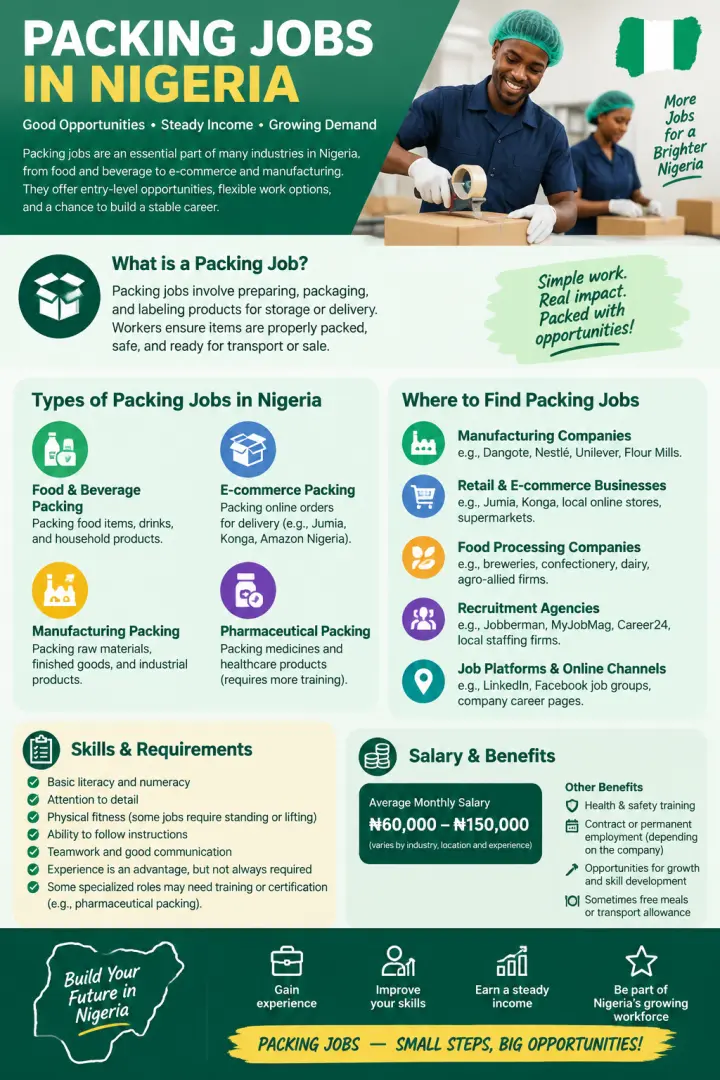
Here's the usual stuff you'll end up doing:
- Counting and checking items against an order or list
- Putting products into boxes, bags, cartons or crates
- Sealing, labelling and stacking packages
- Checking for damaged or expired goods (and flagging them)
- Keeping your work area clean and not blocking walkways
- Loading or offloading trucks, sometimes
That last one catches people off guard. A lot of packing roles quietly include some lifting. Ask about it during the interview so you're not surprised on day two.
Where the jobs are
Lagos, mostly. Not gonna lie, it's where the bulk of the openings sit. Ikeja, Oregun, Isolo, Apapa, Ikorodu and the industrial areas around Agbara and Ota in Ogun State all have factories and warehouses that hire packers fairly often.
But don't stop at Lagos.
Kano has a big manufacturing base. Aba and Onitsha are packed with traders and small factories, so there's always somebody needing hands to bag, label and ship goods. Port Harcourt, Kaduna, Ibadan and Abuja have their share too, especially in food processing, bottling, pharma distribution and supermarket supply chains.
From what I've seen, the sectors that hire the most are:
- Food and beverage companies
- Cosmetics, soap and detergent makers
- Pharmaceutical distributors
- Online stores and fulfilment centres
- Courier and logistics firms
- Poultry, fish and agro-processing businesses
What's the pay like?
Honestly speaking, it varies a lot. Big factories and well-run logistics companies tend to pay better and on time. Small private outfits might pay less, and some pay daily. The national minimum wage is ₦70,000 a month, so a legit full-time employer shouldn't be going below that. Plenty of packers earn somewhere around that figure or a bit above, and overtime can push it up.
Is it a fortune? No.
But consistent pay, sometimes with lunch, transport help or a bonus, is worth more than people think. Especially when you're starting out.
A word on contract types, because this matters. Some packers are permanent staff. A lot are casual or contract workers, or hired through an agency. Agency jobs can be fine, but ask who actually pays you and how often. If nobody can give you a straight answer, that's your cue to walk.
Do you need a certificate?
Usually not a fancy one. Most employers ask for SSCE or even less, and some don't care as long as you can follow instructions and show up. For supervisor roles or anything in a pharma or food-safety setting, they may want more, like an OND or some experience.
What they really want is simple. Be on time. Be honest. Be able to stand for hours without complaining every ten minutes.
Speed and neatness help a lot. A packer who's quick but sloppy gets complaints. One who's slow but careful gets complaints too. The sweet spot is steady and accurate, and you'll get there faster than you think.
Finding real openings
Start with the obvious places. Job boards like Jobberman and MyJobMag list warehouse and packing roles regularly. LinkedIn has some too, though mostly for the bigger companies. Search terms like 'packer', 'warehouse assistant', 'production operator' and 'dispatch assistant' will show you more than just typing 'packing job'.
Then there's the old way, which still works.
Walk to industrial areas. Talk to security at factory gates (they often know when HR is hiring). Ask friends or family who work in factories. A lot of Nigerian companies fill packing roles through referrals before they ever post anything online. I've seen people get hired this way within a week.
Facebook and WhatsApp groups for job seekers in your city can be useful too. Just be careful with them, and I'll explain why in a second.
The scam problem (read this part twice)
Look, this is where people get hurt. Because packing jobs don't need much experience, scammers love them. They know you're hopeful and probably a bit stretched.
Red flags I'd watch for:
- Anyone asking you to pay for 'registration', 'uniform', 'training' or 'slot' before you start
- Job offers that arrive without any interview at all
- Promises of crazy salaries for simple work
- Recruiters who only talk on WhatsApp and won't tell you the company's address
- Pressure to pay or decide today because 'the slots are filling'
Real employers don't charge you to work for them. Full stop.
If something feels off, check the company's website, look up the address on Google Maps, and ask someone who knows the area. Takes ten minutes. Could save you ₦20,000 and a lot of stress.
How to stand out when everyone's applying
Packing jobs attract many applicants. So small things matter.
Keep a simple CV. One page is plenty. List any past work, even if it was helping at a shop, selling at a market or working at a relative's business. That's experience. Add your phone number and make sure it's actually reachable. You'd be surprised how many people miss calls because their phone is off or on silent.
When you show up for an interview or test, dress neat and wear closed shoes if you can. Some companies run a quick practical test, like counting items or packing a box against a timer. Stay calm. They're looking at how you handle it more than whether you're perfect.
And be honest about your availability. If the job has night shifts and you can't do nights, say so now. Saying yes and then disappearing after two weeks burns bridges, and the HR world in Nigeria is smaller than you'd think.
Is it worth it long-term?
Depends on what you do with it.
If you treat it as just a paycheck, it stays that way. But a lot of people move up from packing to stock control, to dispatch, to team lead, even to warehouse supervisor. Some learn how the whole supply chain works and later start their own small distribution or packaging business. That's real.
Pay attention while you're there. Learn how orders flow, who handles inventory, how deliveries get scheduled. Ask questions (politely). Supervisors notice people who care.
Also, the body part. Standing all day, lifting, repeating the same motion. Look after your back and wear comfortable shoes. Sounds small until week three.
Quick starter checklist
- Update your CV and keep a few copies ready
- Set up job alerts on a couple of job boards
- Visit industrial areas near you and ask around
- Never pay anyone to get a job
- Confirm pay, shift times and contract type before accepting
- Show up early on day one
Packing work isn't glamorous, I'll admit that. But it's real, it's available, and for plenty of Nigerians it's the first step to something steadier. Start applying this week, not next month.