

Let me start with something people don't say enough. Driving is still one of the few jobs in Nigeria where you can start with almost nothing but a licence and a clean record, and be earning within a couple of weeks.
Not easy money. But real money.
The types of driver jobs you'll actually find
Most people think driver job means one thing. It doesn't. From what I've seen, the work splits into a handful of lanes, and they pay and feel very differently.
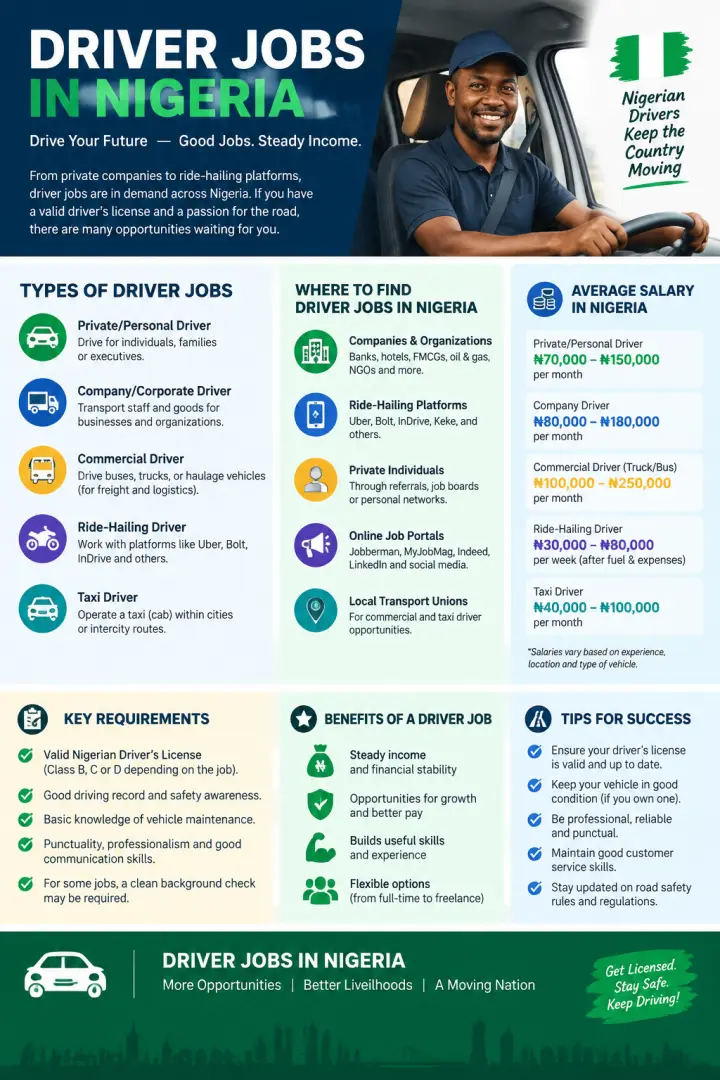
- Private or family driver: You drive one household or one boss. Steady pay, fixed hours (sometimes), and a lot of waiting around.
- Company driver: Staff shuttle, delivery vans, sales reps, NGO field work. You get a uniform, sometimes HMO, sometimes nothing but salary.
- Ride-hailing: Uber, Bolt, inDrive. You're your own boss, which also means you're your own problem when the car breaks down.
- Truck and trailer driver: Long-distance haulage, cement, goods from Apapa port, food moving up north. Hard on the body, better pay.
- Tanker driver: Fuel and gas. Risky, but the pay reflects that.
- Dispatch rider: Technically a rider, not a driver, but people searching for driver jobs often end up here. Lots of logistics startups hire them.
- Bus driver: Schools, churches, hotels, staff buses, interstate transport companies.
Pick based on your life, not just the salary. A married man with kids probably shouldn't be on a three-week haulage trip rotation unless the money really justifies it.
What do they actually pay?
Honestly, this changes all the time, and fuel prices since the subsidy removal haven't helped anyone's calculations. So treat these as rough numbers, not promises.
Private drivers in Lagos and Abuja usually land somewhere between ₦70,000 and ₦150,000 a month. Some rich households or expat families pay more, especially if you're also handling errands or doing late nights. Outside the big cities, expect lower.
Company drivers tend to sit in a similar range, but the extras matter. Overtime, feeding allowance, transport, even a small bonus at December. Ask about all of it.
Truck drivers can pull ₦150,000 to ₦300,000 or more monthly when you add trip allowances, though it depends a lot on the company and the route. Tanker work often pays at the higher end.
Ride-hailing? That one's tricky. Some days you'll make good money. Other days after fuel, data, the platform's cut and your own food, you've basically paid to sit in traffic. Not gonna lie, I've heard more drivers complain about it lately than praise it.
The documents you need before anyone takes you seriously
Get your paperwork sorted first. Seriously. Employers skip people over this all the time.
- A valid driver's licence issued by FRSC (check the expiry date, don't wait till it lapses)
- National ID or NIN slip
- Passport photographs
- Guarantor form, usually with two guarantors who have stable jobs or a business
- Proof of address
- Recommendation or reference from a past employer, if you have one
- Medical fitness report (many companies ask for this, especially for trucks and buses)
Heavy trucks and commercial passenger vehicles may need a different licence class or extra training. Check with FRSC or the company before you apply so you don't waste weeks.
Oh, and keep your licence photocopies in a clean file. Sounds small. It makes you look serious.
Where to look for jobs (and where not to)
Word of mouth still wins. A pastor, an uncle, a neighbour who works in a company, a security man at an estate who knows who needs a driver. That's how a huge number of private driver jobs get filled in Nigeria.
But online helps too.
- Job sites like Jobberman, MyJobMag and Indeed Nigeria
- Facebook groups for drivers and domestic staff in your city
- WhatsApp groups (be careful here, more on that below)
- Direct visits to logistics yards, bus terminals and transport companies
- Recruitment agencies that place domestic staff and drivers
Walk-ins work better than people think. Go to a haulage company's office, dress neat, carry your documents, ask for the transport manager. Plenty of drivers got their break that way.
Watch out for the scams
Look, this part matters. If anyone asks you to pay money before you start work, be suspicious. Registration fee, uniform fee, training fee, "slot" fee. Real employers don't normally charge you to take a job.
Some agencies do charge for placement, and that's different, but get a receipt and know exactly what you're paying for.
Also, be careful with offers of a brand new car for you to "own after one year" with weekly remittance. Sometimes it's legit hire-purchase. Sometimes it's a trap where you pay for two years and never own anything. Read every line. Get a lawyer or at least a smart friend to read it with you.
How to stand out when ten other drivers are applying
Plenty of people can drive. Fewer can be trusted.
That's the whole game, really. A boss wants someone who arrives on time, doesn't disappear with the car, doesn't hide accidents, and doesn't gossip about the family. Skill is expected. Character is what gets you hired.
A few things that help:
- Know the city. Learn routes, shortcuts, and which roads flood when it rains.
- Be able to do basic car checks: oil, water, tyres, brake fluid, battery.
- Dress clean for the interview. Trimmed nails, ironed shirt, polished shoes.
- Speak politely. Say sir or ma when it fits.
- Take a defensive driving course if you can. It's cheap compared to what it adds to your CV.
And if you can handle a bit of English, even simple English, you'll do better with expat employers and corporate clients. Some people sleep on that.
The part about Lagos traffic nobody tells you
You'll spend hours in it. Hours.
If you're applying for a Lagos job, ask what the daily route looks like. A job that starts at 6am from Ikorodu to Victoria Island is a very different life from one in Ikeja. I know a man who took a good-paying private driver job and quit after four months because he was leaving home at 4:30am and getting back after 10pm. The money was fine. His marriage wasn't.
Same thing in Abuja, though it's usually kinder. Port Harcourt has its own wahala. Kano, Kaduna and Ibadan are generally calmer, though pay can be lower.
Should you buy your own car for ride-hailing?
Hmm. Depends.
If you have the cash, a fuel-efficient car and a reliable mechanic, it can work. Think Toyota Corolla, Honda Civic, or something similar that spare parts are easy to find for. But if you're stretching to buy a car on loan or borrowing from family, the pressure can sink you quickly.
Maintenance eats people alive. Tyres, brake pads, suspension, insurance, platform fees, police wahala sometimes, inspection stuff. Do the monthly maths honestly before you commit. Many drivers I've spoken to say the sweet spot is working with an owner who gives you a fair remittance deal, at least until you've saved enough to try your own.
Staying safe on the job
People joke about it, but road safety is the real job. One bad accident and you can lose the car, the work, and worse.
Don't drive tired. Don't use your phone while moving. Don't overload a vehicle because the boss is pushing you. If a truck has bad brakes, say so and put it in writing if you can, even a WhatsApp message. It protects you later.
For long-distance work, rest at proper stops, avoid night travel on risky routes when you can, and tell someone your location. Boring advice, yes. It's also how people get home.
Where this job can take you
A lot of people treat driving as a stopgap. Some are right. But others build real careers from it.
You can move from private driver to fleet supervisor. From one truck to managing a few. Some save up, buy a Keke or a bus, and hire other drivers. Some become driving instructors. Others move into logistics coordination, which pays better and doesn't need you behind the wheel all day.
The ones who go far usually do the same things. They save a little each month, keep their name clean, and learn how the business actually runs. Ask questions. Watch how dispatch works, how routes get planned, how the boss makes money.
That knowledge is worth more than a few extra naira on payday.
One last thing before you apply
Start small if you have to. Take the first decent job, learn, build a reference, then move up. Nobody lands the best driver job in Nigeria on day one.
Get your licence in order this week. Ask two people you trust to be your guarantors. Then start knocking on doors.