
Ask any guy standing outside a Nairobi stage what the easiest job to start is, and half of them will say driving. Fair enough. Vehicles are everywhere, and somebody always needs to get people or goods from point A to B.
But 'easy to start' and 'easy to earn well' are two different things. I've watched people jump in, burn out in six months, and quit. I've also seen others quietly build a decent life behind the wheel. So what separates them?
The kinds of driver jobs you'll actually find
Kenya's driving market is wider than most people think. Here's the rough breakdown.
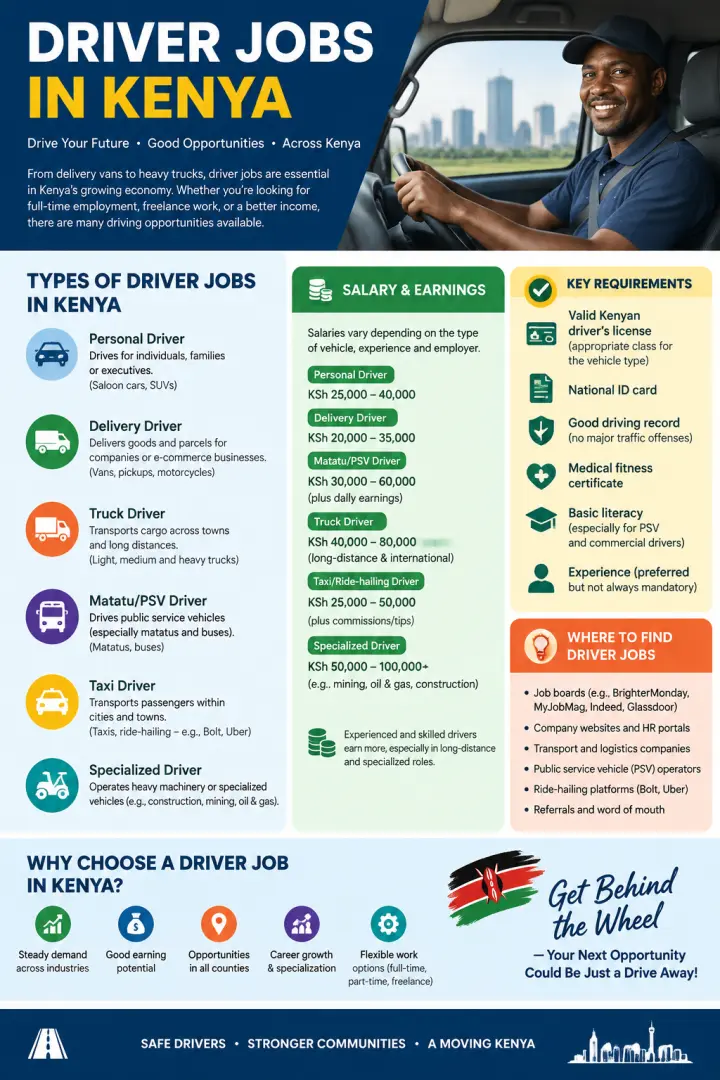
- Personal or family driver. You work for one household or one boss. Steady, usually.
- Company driver. Think NGOs, hotels, schools, supermarkets, security firms.
- Matatu and bus driver. PSV work, city routes or upcountry.
- Truck driver. Local deliveries or long haul across the border.
- Ride-hailing. Uber, Bolt, Little and the like.
- Tour driver. Safari guides who drive, mostly around Nairobi, Mombasa, Maasai Mara and Amboseli.
- Delivery and van drivers. Pickups, distribution, courier work.
Each one pays differently and treats your time differently. Pick based on your life, not just the salary number.
Paperwork first. Always.
Honestly, this is where a lot of people slip. You can be the smoothest driver in Kenya, but with missing documents most employers won't even look at you.
You'll need a valid driving licence with the right class for the vehicle you're applying to drive. Your ID. A Certificate of Good Conduct from the police (DCI). Many employers also want a recent medical report, and some ask for references from past bosses.
Want to drive a matatu or a bus? You'll need a PSV badge on top of the licence. For heavy trucks, you need the correct class for them, not just a basic light-vehicle licence. Check the current NTSA requirements before you spend any money, because rules and classes get updated.
Quick tip: keep clean photocopies of everything in one folder. Sounds silly. It saves you when someone says 'bring your documents tomorrow morning'.
What do drivers earn in Kenya?
Depends. I know that's annoying, but it's true. Here's what I've seen and heard, and please treat these as rough ranges, not promises.
Personal and company drivers
Personal drivers in Nairobi often land somewhere around Ksh 15,000 to 35,000 a month. Go higher with a good employer, an executive, or a diplomatic household. Outside Nairobi it's usually lower. Company drivers can earn similar money, with the bonus of NHIF/SHA and NSSF contributions if the company does things properly.
Matatu and bus drivers
Most work on a daily target. You pay the owner an agreed amount, and whatever's above that is yours. Good days feel great. Slow days, rainy days, or days when the police are out... not so much. Income is all over the place.
Truck drivers
This is where the bigger money sits. A long-haul driver on the Mombasa to Malaba or Mombasa to Kampala route can make anywhere from Ksh 40,000 to 80,000 or more, once you count allowances. Cross-border runs to South Sudan, Rwanda or DR Congo sometimes pay more. But you're away from home for days, sometimes weeks. Think about that honestly.
Ride-hailing
Gross earnings look nice until fuel, the app's commission, insurance, parking and maintenance chip away at them. Plenty of drivers, especially those paying off a car loan, tell me they take home far less than they expected. If you own the car outright and drive smart hours, it's a better story.
Where to actually look for openings
Don't just sit refreshing one website. Mix it up.
- Job boards like BrighterMonday, MyJobMag Kenya and Fuzu
- Facebook groups for drivers (careful here, more on that below)
- Transport and logistics companies directly, many hire through their offices or websites
- Driver training schools, which often know who's hiring
- Word of mouth. Seriously. A lot of good driving jobs never get advertised.
Tell people you're looking. Your old boss, the mechanic you trust, the guy at the petrol station you've known for years. Referrals carry weight in this industry, maybe more than your CV does.
Watch out for scams
Not gonna lie, this part makes me angry. Every few months I hear about someone who paid Ksh 5,000, 10,000, even 50,000 for a 'guaranteed driver job' abroad or with a big company. Then the person disappears.
A real employer doesn't charge you to apply. Same goes for agents promising Dubai, Qatar or Saudi driving jobs for an upfront fee, so check any agency with the National Employment Authority first. If someone's rushing you to pay today, walk away.
Also, verify the company exists. Visit the office if you can. Call the number. Ask other drivers what they know.
Skills that make employers pick you
Driving is the baseline, of course. But employers hiring in Kenya keep telling me the same stuff, and it's rarely about fancy skills.
They want somebody who shows up on time. Who doesn't drink before a shift. Who can handle Nairobi traffic without losing his temper (Thika Road at 6pm, anyone?). Who knows basic vehicle checks, like oil, tyres and brakes, and doesn't wait for the car to break down before telling anyone.
Honesty matters a lot too. Fuel money, cargo, a boss's family in the back seat. Trust is the real currency.
A few extras that help:
- Basic English and Swahili, so you can talk with anybody
- Smartphone skills, since maps, apps and tracking are everywhere now
- A defensive driving or first aid certificate
- Basic mechanical knowledge
- A clean driving record, no piled-up traffic offences
Is extra training worth the money?
In my experience, yes, if you pick wisely. A defensive driving course from a recognised school can set you apart, especially for corporate and NGO jobs. They like seeing it on paper because insurance companies like it too.
Want to move into heavy trucks or buses? Get the right licence class and then train under someone experienced. Don't jump straight to a trailer on your own after one week. That's how accidents happen.
The tough side nobody puts in the job ad
Long hours. Bad roads. Police stops. Back pain. Being away from family. Employers who delay pay, or change the agreement halfway through the month.
So get things in writing. Even a simple contract with your salary, off days, overtime and who pays for fines. If a boss refuses to write anything down, that tells you a lot.
Check on insurance too. Is the vehicle covered? Are you covered if something goes wrong? Do they pay NSSF and SHA? Ask before you sign, not after the accident.
Moving up from just 'driver'
Some drivers stay drivers for thirty years and are happy. Totally fine. Others want more, and there are ways to get it.
Personal drivers move into transport supervisor roles. Truck drivers become fleet managers or start with one second-hand lorry of their own. Matatu drivers save toward owning a vehicle. Tour drivers learn the guiding side and become full safari guides, which pays better.
It doesn't happen quick. But the people who do it all did one thing in common: they saved, they stayed clean, and they kept their reputation spotless.
Where I'd start if I were you
Sort your documents this week. Seriously, today if you can. Then pick one type of driving job and learn it properly, instead of applying for everything at once. Talk to three drivers already doing it and ask what they wish they'd known.
And be patient. The first job might not be perfect. But a good one, with a decent boss, fair pay and a clean record behind it, opens the next door pretty fast.