

What kind of driver job are you looking for?
A delivery van in Milan, a truck crossing into France, an airport transfer in Rome — they’re all driving jobs, but the licenses, hours and pay can be very different.
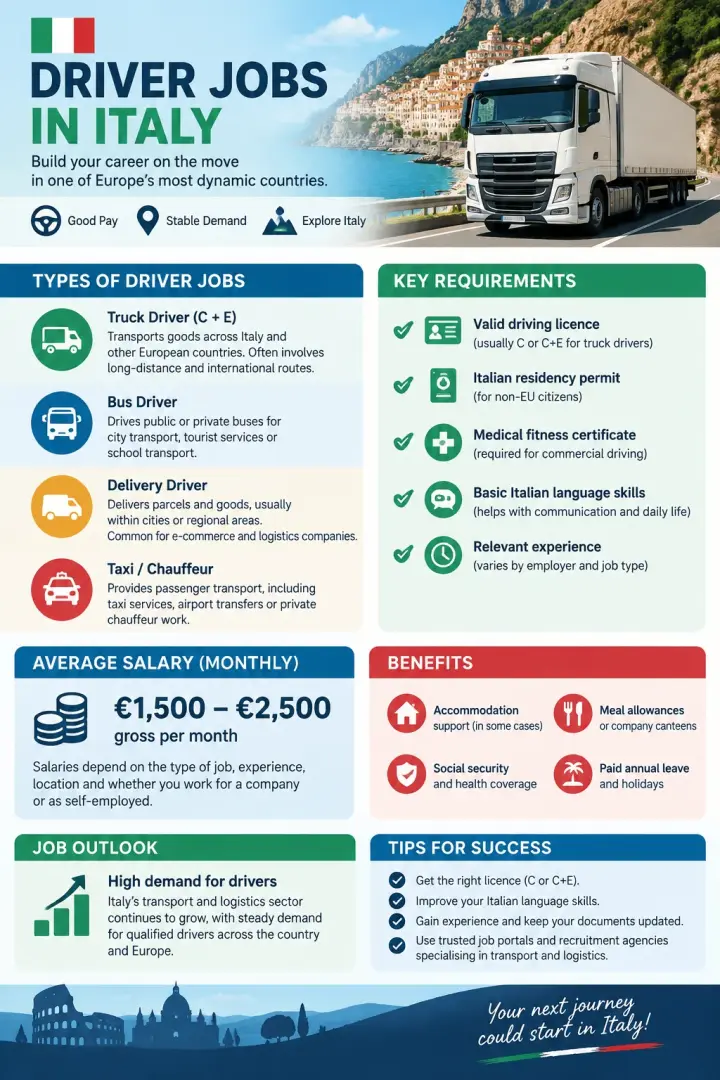
Italy has opportunities for local delivery drivers, long-distance truck drivers, bus drivers and private hire drivers. Some jobs let you finish close to home every evening. Others can mean early starts, overnight trips or weekends away. So before sending out applications, get clear on the sort of working week you actually want.
Driver jobs you’ll find in Italy
Delivery van and courier work
Online shopping keeps plenty of vans on the road. Courier companies, supermarkets and local businesses hire drivers to deliver parcels, food, furniture and other goods. You’ll find these roles around big cities like Milan, Rome, Turin and Bologna, as well as in smaller towns.
A standard category B license is usually enough for a van with a maximum authorized weight of up to 3.5 tonnes. Check the vehicle details in the advert, though. A heavier vehicle or certain trailer combinations may need another license.
Look closely at how the job’s set up. Some couriers are employees; others work for a subcontractor or operate as self-employed drivers. Ask who pays for fuel, insurance, parking and the vehicle. Those details can make a big difference to what you take home.
Truck and HGV jobs
Long-distance freight is a big part of Italy’s transport sector. Drivers move everything from supermarket stock to machinery, often between logistics hubs in northern Italy and destinations across Europe.
For a large goods vehicle, you’ll generally need a category C license. For a truck with a heavy trailer, it’s usually category CE. Professional goods drivers also generally need a valid Carta di Qualificazione del Conducente, or CQC merci, unless an exemption applies. Adverts may mention code 95 as proof of professional qualification.
Some employers want experience with refrigerated loads, articulated trucks or warehouse deliveries. An ADR certificate can help if you want to carry dangerous goods, although you won’t need it for every truck job.
Bus and coach driving
Bus drivers may work on city routes, school services, airport transfers or tourist trips. For larger passenger vehicles, look for the category D requirements in the job advert. Smaller buses may fall under D1, depending on the vehicle.
Professional passenger drivers generally need CQC persone too, unless an exemption applies. Some jobs involve split shifts, where you work in the morning, have a long break and return later. Others are seasonal, especially in tourist areas.
Taxi and private hire
Taxi and private hire jobs aren’t quite the same as ordinary delivery driving. A taxi license is tied to local rules, while private hire with a driver is often called NCC, short for noleggio con conducente.
You may need a professional driving certificate, registration and local authorizations. Requirements depend on the role and the municipality, so check with the local Comune and the employer before paying for a course or making plans. And don’t assume that signing up with an app is enough to start carrying passengers.
Can you use your current driving license in Italy?
If your license was issued by an EU or EEA country, it’s generally recognized in Italy while it remains valid. Rules around renewal and residence can still matter, so check with the Italian transport authorities if you’re moving for the long term.
For a license issued outside the EU or EEA, the answer depends on where it was issued and your residence status. In many cases, a non-EU license can be used for up to one year after becoming resident in Italy, with an official translation or an international driving permit where required. After that, you may need to exchange it or get an Italian license.
Not every foreign license can be exchanged. Italy has agreements with certain countries, and those agreements can change. Check the current rules with the Motorizzazione Civile before assuming you can swap yours without taking tests.
One more thing: having the right vehicle category doesn’t automatically mean you have the professional qualification needed for paid truck or bus work. Check your CQC or code 95 status separately.
Do you need a visa or work permit?
EU and EEA citizens can generally work in Italy without a work visa. They’ll still need to take care of practical steps such as getting a codice fiscale, the Italian tax identification number, and registering their residence when required.
If you’re from outside the EU or EEA, a valid driving license alone won’t give you permission to work. You’ll normally need the right residence and work authorization, unless you already hold a permit that allows employment.
For many people applying from abroad, an Italian employer must first request a work authorization called a nulla osta. The applicant can then apply for the relevant visa and, after arrival, a residence permit. Hiring may depend on the current Decreto Flussi rules, quotas and application windows.
These rules change. Check current guidance from the Italian embassy or consulate and ask the employer which route applies to your situation. Be careful with anyone promising a guaranteed visa in exchange for a large upfront fee.
Where to search for driver jobs in Italy
Start with EURES, the European job mobility portal, and Cliclavoro, Italy’s public employment portal. You can also look at the careers pages of courier companies, transport firms, bus operators and supermarkets. Local staffing agencies often advertise warehouse and delivery roles too.
Italian search terms help. Try a few of these when you’re looking online:
- Autista patente B — category B driver, often for vans or local deliveries.
- Autista patente C or CE — truck driver with a C or CE license.
- Autista CQC merci — professional goods driver with CQC.
- Autista autobus CQC persone — bus driver with passenger CQC.
- Corriere or autista consegnatario — courier or delivery driver.
- Autista NCC — private hire driver.
Add a location such as Milano, Roma, Bologna or Verona to narrow things down. Northern Italy has many logistics and manufacturing centers, while tourist destinations can offer more seasonal passenger-driving work. But don’t rule out smaller towns — a local transport company may advertise only on its own website or through an agency.
What about English-speaking jobs?
They exist, especially with international transport companies or in tourism. But many employers expect at least basic Italian, and for good reason: you may need to speak with customers, follow site instructions or deal with a delivery problem.
For bus, taxi and private hire roles, conversation with passengers can be a bigger part of the job. You don’t have to sound like a local, but being able to understand addresses, safety instructions and phone calls helps.
Pay, contracts and the questions to ask
There isn’t one reliable salary for every driver job in Italy. Pay depends on the vehicle, region, experience, hours, allowances and whether you’re an employee or self-employed. A long-haul truck job with nights away shouldn’t be compared with a part-time local delivery job on the monthly figure alone.
Ask whether the amount in the advert is gross or net. Gross pay is before deductions; net pay is what reaches your account after applicable deductions. If an employer talks about a daily rate, find out how many days are actually guaranteed.
It’s also worth asking about:
- The national collective agreement, or CCNL, applied to the job and your pay level.
- Overtime, night work, weekend pay and any travel or meal allowances.
- Who provides the vehicle and pays for fuel, tolls, parking and maintenance.
- Whether loading, unloading and waiting time count as working time.
- How often you’ll sleep away from home and whether accommodation is covered.
- Paid leave, probation, contract length and the expected weekly schedule.
Don’t rush past the contract. If the advert says a driver can earn a high amount but won’t explain the hours or costs behind it, ask for the details in writing.
Driving hours and rest breaks
Many professional truck and bus jobs are covered by EU rules on driving time, breaks and rest. For example, drivers covered by those rules generally need a break of at least 45 minutes after no more than 4.5 hours of driving. That break can be split in a prescribed way.
Daily and weekly limits apply too. A tachograph is used in many covered vehicles to record driving and other activity, and drivers who use a digital tachograph generally need a valid driver card. Ask the employer what’s required for the specific vehicle and route.
Not every delivery job falls under the same tachograph rules, and there are exceptions. Working-time rules can still apply even when a particular journey is exempt from EU driving-time rules. If a company expects you to skip breaks or record work incorrectly, walk away.
How to make your application stronger
Put your license categories near the top of your CV. It saves a recruiter from hunting through two pages to find out whether you can drive the vehicle.
Then add the useful details: CQC goods or passenger qualification, code 95 if applicable, ADR, digital tachograph card and any relevant expiry dates. Mention the type of vehicle you’ve driven, the routes you know and whether you’ve handled loading or customer deliveries. A short CV in Italian can help, even if the advert is in English.
Keep copies of your documents ready, but don’t send sensitive information to an unverified contact. Check the company’s website, business details and email address first. A real employer should be able to explain the role, contract and hiring process clearly.
And if you’re moving from abroad, sort out the license and work-permission questions early. Getting a promising interview is exciting. Finding out afterward that you can’t legally take the job? Not great.