
Standing at a packing line for a full shift isn't everyone's idea of a dream job. But if you like practical work, clear tasks and keeping busy, packing jobs in Ireland can be worth a look.
You might be putting food into boxes in Cork, labelling healthcare products in Galway or getting online orders ready for delivery near Dublin. The job titles vary quite a bit, too. Search only for “packer” and you could miss a lot.
What does a packing job actually involve?
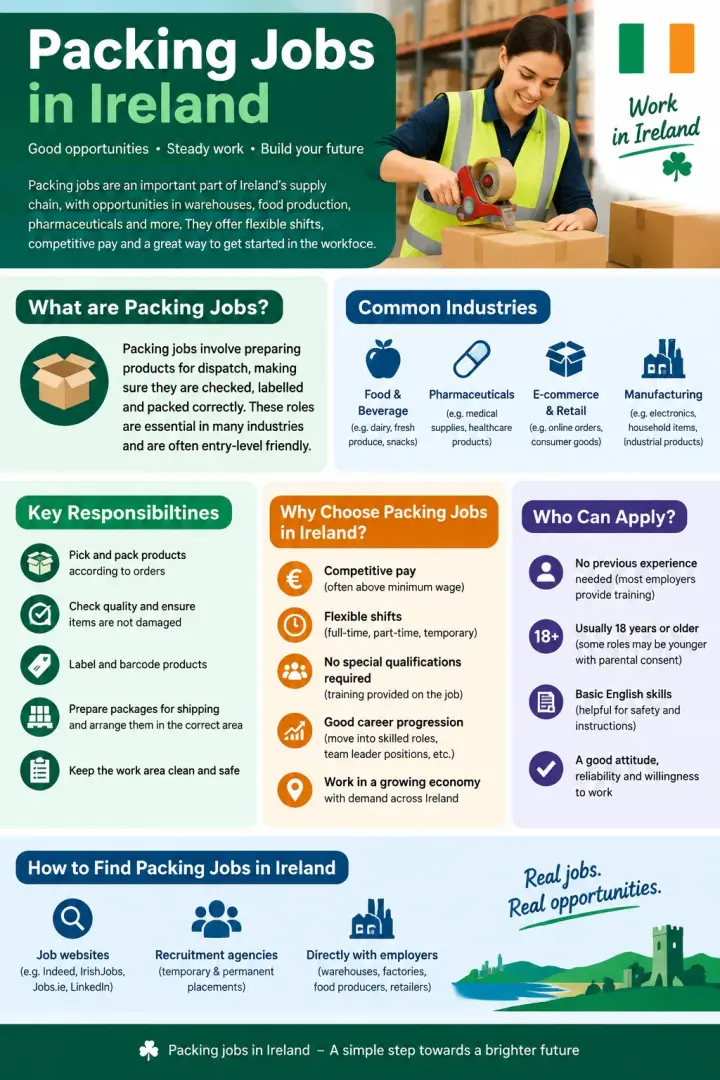
A packer's main job is to get products ready for storage, transport or sale. That could mean filling boxes, checking labels, sealing bags or making sure an order has the right items before it leaves the warehouse.
Some roles are fast-paced. Others need a steadier hand.
In a food factory, you might work beside a production line, check use-by dates and follow strict hygiene rules. In a warehouse, you could pick items from shelves, scan them and pack them for customers. A medical products company might ask you to work in a cleanroom, where clothing and cleanliness rules are taken seriously.
Expect to spend time on your feet. Depending on the job, there may be lifting, repetitive movements, shift work or a chilly working area (particularly with food). Read the job ad carefully, and ask questions if it doesn't say much about the day-to-day work.
Types of packing jobs you'll find in Ireland
Food packing and production
Food producers hire packing staff for meat, dairy, baked goods, ready meals and other products. You could be weighing portions, checking packaging or placing finished goods into cartons.
Hairnets and protective clothing are common. So are early starts.
Some employers train new starters on hygiene and food safety, so a lack of experience doesn't always rule you out. That said, previous factory or food-handling work can help your application.
Warehouse packing and order picking
These roles often combine picking and packing. You'll collect products for an order, check quantities, scan items and prepare parcels for collection. Warehouses serving online shops, supermarkets and delivery companies all need this kind of work.
Look out for titles like warehouse operative, order picker, dispatch operative and fulfilment associate. They don't all mean exactly the same thing, but there's often overlap.
Pharmaceutical and medical device packing
Ireland has a large pharmaceutical and medical device industry, with employers in places such as Cork, Galway, Limerick and Dublin. Some packing roles involve carefully checking labels and recording details for each batch. Accuracy matters here—a small mistake can hold up a lot of work.
Requirements vary. One employer might offer training, while another asks for production experience or familiarity with cleanroom rules. A packing job in this sector isn't necessarily the same as a skilled manufacturing or laboratory role, so check the duties before you apply.
Seasonal and temporary work
Busy shopping periods, harvests and production peaks can bring extra vacancies. Temporary packing jobs may last a few weeks or several months, and some are filled through recruitment agencies.
For anyone looking for a quicker start, that's worth checking. Just make sure you know how long the assignment is expected to last and whether the hours are guaranteed. A temporary role can lead to something longer, but it isn't a promise.
Where should you look?
Dublin and the surrounding counties have plenty of warehouses and distribution centres, though rent and commuting costs can be high. You'll also find production and packing work around Cork, Galway, Limerick and Waterford, as well as in smaller towns with food factories or manufacturing sites.
Don't ignore the industrial estate down the road. Some useful places to search include:
- JobsIreland, the public employment service's jobs website.
- Major job sites such as Indeed and IrishJobs.
- EURES, especially if you're looking from another European country.
- Recruitment agencies that place warehouse, factory and production staff.
- Company career pages for local food producers, retailers and manufacturers.
Try searches such as “packing jobs Dublin”, “food packing jobs Cork” or “warehouse operative Ireland”. Add “night shift”, “part-time” or “no experience” if those fit what you need. And check the actual location—an advert may say Dublin even though the workplace is outside the city centre.
How much do packing jobs pay in Ireland?
Pay depends on the employer, location, duties and shift pattern. Entry-level roles may be advertised at or around the legal minimum hourly rate, while some jobs pay more for experience, nights, weekends or specialist settings.
Rates and legal minimums can change. Check the current national minimum wage on the Workplace Relations Commission website, and read the ad to see whether the quoted rate is before tax. Age-related rates may apply in some cases.
Don't just compare the biggest number on the page. A higher hourly rate might include a shift allowance, or it might apply only after training. Ask about overtime rates, paid breaks, weekly hours and whether transport or uniform costs come out of your wages.
For a rough comparison, multiply the hourly rate by the expected weekly hours. That's your gross pay before tax and other deductions—not the amount you'll necessarily take home.
Hours, breaks and the small print
Full-time and part-time packing jobs are both available. Some factories run early, late or overnight shifts; others operate Monday to Friday during the day. Rotating shifts can be tricky if you're relying on public transport, especially when a shift starts before the first bus.
In general, employees in Ireland are entitled to a 15-minute break after working more than 4.5 hours and a 30-minute break after more than six hours. The 30 minutes can include the earlier break. Breaks don't generally have to be paid, and some exceptions or different arrangements can apply.
You'll usually build up paid annual leave too, including when you work part-time. Your entitlement depends on your hours and circumstances. The Workplace Relations Commission has current guidance on breaks, holiday pay and other employment rights.
Before accepting an offer, ask for the key terms in writing. Who's your employer—the agency or the company where you'll work? How are shifts assigned? And is the role permanent, fixed-term or an agency assignment?
Do you need experience?
Not always. Plenty of entry-level packing jobs offer on-the-job training, particularly for straightforward warehouse or production tasks. Employers may care more about reliability, attention to detail and whether you can work the required shifts.
That doesn't mean the work's easy. You'll often need to keep up with a line, follow safety instructions and notice when something's wrong with a label or package.
Depending on the role, an employer may ask for:
- Basic English for understanding instructions and safety signs.
- Experience using a scanner or working in a warehouse.
- Food hygiene knowledge or factory experience.
- Comfort with standing, lifting or repetitive tasks.
- A forklift licence for jobs that include forklift driving—not usually for a basic packing role.
If the ad mentions manual handling, ask whether training is provided. Employers have duties around workplace safety, and you shouldn't be expected to lift something unsafe just to look keen.
Can you apply from outside Ireland?
Yes, but your right to work comes first. Irish and UK citizens can generally work in Ireland without an employment permit under the Common Travel Area. Citizens of EU and EEA countries and Switzerland can generally work without an Irish employment permit too.
For people from outside those groups, the rules depend on immigration status and the job. Some people already have permission to work in Ireland; others need an employment permit or a different permission that allows work. A visa, an employment permit and immigration permission aren't the same thing.
Here's the tricky bit: not every job qualifies for an employment permit. Many lower-skilled packing or warehouse roles may not be eligible, depending on the occupation and current rules. Don't assume an employer can sponsor you just because an advert says it's hiring overseas.
Check the current occupation lists and permit rules on the Irish government's enterprise department website. For visa and immigration questions, check Irish Immigration Service Delivery. Get the exact job title and duties from the employer before spending money on an application or travel.
Getting your application ready
A short, clear CV is often enough for an entry-level packing role. Put your contact details near the top, followed by recent work experience and any useful training. If you've handled stock in a shop, cleaned in a busy workplace or worked shifts in hospitality, say so. Those skills can transfer.
Be specific where you can. “Packed customer orders and checked quantities” tells an employer more than “worked in a warehouse”. Mention scanners, production lines, hygiene procedures or manual handling training if you've actually used them.
New to work? Include volunteering, school projects or other responsibilities that show you can turn up on time and follow instructions. There's no need to invent experience.
And check your phone number before sending the CV. Sounds obvious, but a missed digit can cost you an interview.
What might they ask at an interview?
A packing interview may be short and practical. The employer could ask about your availability, how you handle repetitive work or what you'd do if you noticed a damaged product. Some companies include a simple assessment or a walk around the workplace.
Have a few questions of your own ready. What does a normal shift look like? How heavy are the items? Is training paid, and how do people get to the site for an early start? Those details can make a bigger difference than a polished job title.
Watch out for dodgy job offers
Not every advert is genuine. Be careful if someone promises a guaranteed job and visa, won't name the employer, or pressures you to pay upfront for recruitment, a work permit or a place on a training course.
Check the company and agency independently. Use contact details from their official websites rather than relying only on a message you received. Don't send passport or bank details to an unverified contact, and don't accept vague answers about wages or the workplace.
There may be genuine government application fees in some immigration processes, but that doesn't make an unexplained payment to a recruiter safe. If you're unsure, check the rules with the relevant Irish government service before paying.
Ready to start looking?
Set up a few job alerts with different titles and locations. Then check the shift times, pay details and travel route before firing off an application.
The right packing job isn't just the one that hires fastest. It's one you can get to, do safely and fit around the rest of your life.