

What kind of driving job are you looking for?
A delivery driver dropping parcels around Cork has a pretty different working day from an articulated truck driver heading out of Dublin Port at 5 a.m. Both are driver jobs in Ireland, but the licence, hours and pay can look completely different.
Start with the vehicle you’re allowed to drive. Then look at the hours you can actually live with. Early starts sound manageable until the alarm goes off at 4:30.
Driving jobs turn up across Ireland, from busy city delivery routes to rural school runs and long-distance haulage. Some employers want experienced drivers straight away. Others will consider someone with the right licence, a clean record and a willingness to learn.
Driver jobs in Ireland: the main options
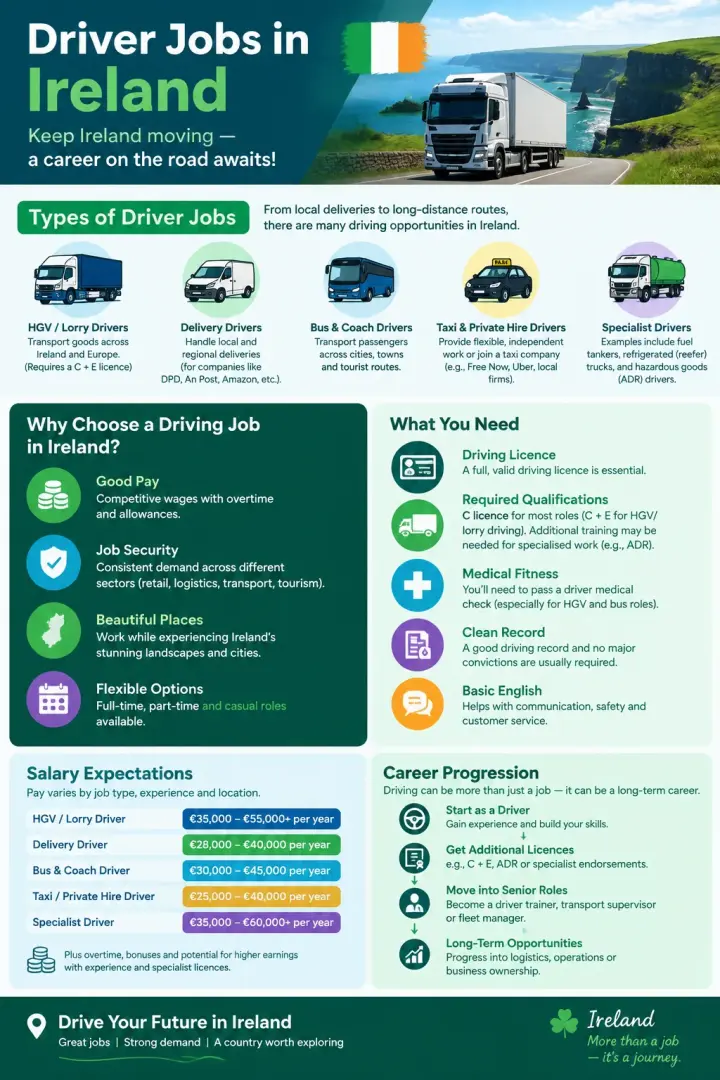
Van and parcel delivery
Van driving is often where people start looking, especially if they’ve got a full category B driving licence. Jobs can involve delivering parcels, groceries, medical supplies or parts to homes and businesses.
The day isn’t just driving, though. You might load the van, scan packages, plan a route and carry items up stairs. In Dublin or Galway, parking alone can eat up a surprising amount of time.
Some roles are directly employed positions with a set wage. Others are offered through delivery contractors or on a self-employed basis. Check who’s providing the van, fuel, insurance and equipment before you agree to anything. That detail can change the value of the job quite a bit.
Truck and HGV driving
Truck drivers move everything from food and building materials to fuel and shipping containers. You’ll see jobs advertised as HGV driver, rigid truck driver, articulated truck driver or by licence category, such as C or CE.
A category C licence covers larger rigid goods vehicles, while CE covers a category C vehicle with a heavy trailer. The exact vehicle and work matter, so check the Irish Road Safety Authority’s current licence rules rather than guessing from the job title.
Some drivers stay close to home, making several drops in one county. Others cover the whole country or take international routes. And yes, there can be paperwork, loading duties and long waits at warehouses alongside the driving.
Bus and coach work
Bus and coach jobs can mean city services, regional routes, school transport, private hire or tourism. You’ll generally need the appropriate passenger vehicle licence, such as category D or D1, depending on the vehicle and role.
Passenger work suits people who can keep their cool. You’re dealing with traffic, timetables and the occasional frustrated passenger, sometimes all at once. Split shifts and weekend work are common in certain roles, so ask what a normal roster looks like.
Some operators advertise training programmes for people who don’t yet hold a bus licence. Those openings can be worth watching if you’re starting from scratch.
Taxi and private hire
Taxi driving offers a different kind of flexibility, though it comes with its own costs and licensing rules. In Ireland, drivers of taxis, hackneys and limousines generally need a small public service vehicle driver licence, often called an SPSV driver licence.
The vehicle also needs to meet the relevant licensing requirements. If you’re thinking of buying or renting a vehicle for the job, check the current rules and costs with the National Transport Authority first. Don’t assume an ordinary car licence is enough.
Specialist driving roles
There are plenty of less obvious options too: refuse collection, recovery vehicles, refrigerated transport, construction deliveries and fuel tankers, for example. Some need extra training or certificates.
For dangerous goods transport, an ADR driver training certificate may be required, depending on the goods and the way they’re carried. A job ad should say what’s needed, but it’s sensible to ask before applying. A crane, tail lift or forklift requirement can also make a difference.
Which driving licence do you need?
It depends on the vehicle, not just the job title. A few categories you’ll see regularly are:
Category B: Cars and certain light vehicles, including many delivery vans. Vehicle weight and trailer limits apply.
Category C1: Certain medium-sized goods vehicles.
Category C: Larger goods vehicles, including many rigid trucks.
Category CE: Category C vehicles with a heavy trailer, including many articulated combinations.
Category D1 or D: Passenger vehicles, with the right category depending on the size and type of bus.
There are age, medical and testing requirements for different categories. If you’re moving from a car licence to a truck or bus licence, you’ll need to go through the relevant application and testing process. The National Driver Licence Service and the Road Safety Authority publish the current rules.
One small thing that catches people out: a job may ask for a full licence held for a minimum period, even when the law doesn’t require that exact amount of experience for the role. That can be an employer or insurance condition. Read the ad carefully.
What about Driver CPC?
Many professional truck and bus drivers need a Driver Certificate of Professional Competence, usually called Driver CPC. This involves an initial qualification where required and ongoing periodic training to keep the qualification current.
There are exemptions for certain types of driving, so don’t assume every truck or bus job has exactly the same requirement. Check the RSA’s guidance for your situation. If an ad asks for an up-to-date Driver CPC card, have the details ready when you apply.
Can you use a foreign driving licence?
That depends on where the licence was issued and your circumstances. EU and EEA licences can generally be used in Ireland while they’re valid, subject to the applicable rules. For licences from other countries, recognition and exchange options vary.
Check directly with the National Driver Licence Service before accepting a job or paying for training. And remember, permission to drive and permission to work are separate things.
How much do driver jobs pay in Ireland?
There isn’t one useful number for every driver. A part-time school bus role, a multi-drop van job and an experienced CE position can come with very different pay arrangements.
Look at the hourly rate or annual salary, but also ask how many hours it covers. A weekly figure can sound good until you find out it includes a long working week, unpaid breaks or shifts that change every few days.
When comparing offers, ask about:
Overtime rates and when they start
Night, Sunday or public holiday pay, if offered
Whether waiting time, loading and paperwork are paid
Guaranteed hours and the usual weekly roster
Pension contributions, sick pay and annual leave
Who pays for required training or licence renewals
For self-employed work, look at the money left after expenses, not just the advertised daily rate. Fuel, vehicle rental, insurance, maintenance and tax can add up. Fast.
Employees have statutory rights, including applicable minimum pay and holiday entitlements. Rates and rules can change, so check the latest information from the Workplace Relations Commission. If an offer seems vague, ask for the details in writing.
Where are the jobs?
Dublin has a large share of delivery, logistics and passenger transport work, with roles around the port, airport, industrial estates and distribution centres. Traffic is part of the deal, of course.
Cork, Limerick, Galway and Waterford have regular demand across distribution, retail deliveries and public transport. You’ll also find jobs around major road links, food production sites and warehouses outside the cities.
Don’t overlook smaller towns. A local building supplier might need a rigid truck driver, while a school transport operator may be looking for someone nearby. Those roles aren’t always advertised as widely as the big national vacancies.
Good places to start your search
Search general Irish job sites and the JobsIreland service, but also check transport companies’ own career pages. Bus operators, supermarkets, courier firms and haulage companies often post openings directly.
Try a few different search terms. “Driver jobs Ireland” is a start, but it’s broad. A more specific search can save you a lot of scrolling:
Van driver jobs Dublin
Delivery driver jobs Cork
Rigid truck driver jobs Limerick
CE driver jobs Ireland
Bus driver trainee Ireland
Part-time driver jobs near me
Recruitment agencies can be useful for temporary and shift work, especially in warehousing and haulage. Ask whether the position is temporary, ongoing or likely to lead to a direct contract. Those aren’t the same thing.
Getting started without driving experience
It’s possible to find an entry-level role, particularly in van delivery. You’ll still need the correct licence and any experience required by the employer or its insurer. Some companies also look for customer service skills, because you’re the person handing over the delivery.
If truck or bus driving is the goal, look for employers that offer structured training. Ask what they cover and whether you’ll have to repay any costs if you leave within a certain period. Get that agreement in writing before you sign.
For a first application, mention useful experience even if it wasn’t a driving job. Did you work early shifts in a warehouse? Handle customer queries? Follow safety procedures on a busy site? That stuff matters.
And be honest about your licence. Don’t list a category you’re still training for as though you already hold it. “Category C in progress” is clear enough.
What employers usually look for
The right licence is the starting point. Beyond that, employers often want someone dependable who’ll look after the vehicle, arrive when expected and speak reasonably to customers.
A good driving record helps. Some employers may ask about penalty points, previous claims or insurance history. Be accurate when you answer; the requirements can vary between companies.
For professional driving roles, relevant CPC records, a digital tachograph driver card where required, and any specialist certificates may be requested. Passenger-facing jobs can involve additional checks. For work with children or vulnerable people, vetting requirements may apply depending on the role.
A CV that gets to the point
Put your licence categories near the top. It saves the person hiring from digging through the page to find the one thing they need to know.
Then add your driving experience, vehicle types and the kind of routes you’ve covered. If you’ve done multi-drop deliveries, say roughly what the work involved. If you’ve handled refrigerated loads or used a tail lift, include that too.
Keep contact details current and check your phone number before sending. Sounds obvious, but a missed digit won’t help.
Questions to ask before accepting a driving job
A quick conversation can uncover details that don’t fit neatly into a job ad. Who loads the vehicle? How are routes assigned? Is there a fixed finish time, or do you work until the deliveries are done?
For a van role, ask how many drops are typical and what happens when traffic or a missed delivery puts you behind. For haulage, ask about nights away, weekend work and whether you’ll use the same vehicle each day. Bus drivers might want to check the split-shift arrangements and the location of the depot.
Also ask about vehicle checks, reporting faults and what support you’ll have if there’s a breakdown. A decent employer should be able to explain how those things work without making it feel like a strange question.
Employee or self-employed?
Some ads use phrases like “be your own boss” or “earn per route”. That doesn’t tell you enough on its own. Ask who the contract is with, how you’ll be paid and what costs you’ll carry.
Employment status depends on the actual working arrangement, not just the label in a contract. If you’re unsure, check guidance from Revenue and the Workplace Relations Commission, or get independent advice. It’s especially worth checking before taking on a van lease or other regular expense.
Working hours and life on the road
Driving can be a good fit if you like working independently and don’t want to sit at a desk all day. But it can also mean early starts, tight delivery windows and plenty of sitting in traffic. The cab might feel like a second home by Friday.
Professional drivers need to follow the driving time, break and rest rules that apply to their work. The exact rules depend on the vehicle and operation, and some driving falls under different rules or exemptions. Your employer should explain the relevant requirements, but it’s a good idea to understand them yourself too.
For multi-drop work, physical fitness matters more than some people expect. Getting in and out of a van dozens of times, lifting parcels and walking up apartment stairs can make for a long day. Ask about typical loads and the equipment provided.
Moving to Ireland for a driving job?
First, check whether you have permission to work in Ireland. Citizens of the EU, EEA and Switzerland generally have the right to work in Ireland, while other applicants may need an employment permit or another immigration permission that allows work.
Not every driving occupation or job offer qualifies for an employment permit. Eligibility can depend on the occupation, salary, employer and current permit rules. Check the official employment permit guidance before paying an agent, booking travel or handing in notice at your current job.
You’ll also need to check whether your driving licence is recognised, whether it can be exchanged and whether your professional qualifications meet Irish requirements. These are separate checks. An employer’s offer alone doesn’t settle them.
And watch out for anyone asking for a large upfront payment in exchange for a guaranteed job or permit. Verify the company, ask for a written offer and use official government sources to check the process.
Common questions about driver jobs in Ireland
Can I get a delivery driver job with a category B licence?
Yes, many van delivery jobs ask for a full category B licence, as long as the vehicle falls within that category’s limits. Employers can still set their own experience and insurance requirements.
Do all truck drivers need Driver CPC?
Many professional truck drivers do, but there are exemptions for certain work. Check the RSA’s current guidance and the details of the job rather than relying on the title alone.
Are part-time driving jobs available?
Yes. School transport, local deliveries, evening courier work and weekend passenger services are a few places to look. Hours can be split or seasonal, so ask how many are guaranteed.
Do I need my own vehicle?
Not always. Many employers provide a vehicle, especially for truck and bus roles. Some delivery and taxi arrangements require you to supply or rent one. Check insurance, fuel and maintenance responsibilities before accepting.
What should I have ready when applying?
Have your CV, licence categories and relevant certificates to hand. You may also be asked for references, proof of permission to work or details of your driving record later in the process. For a specific vacancy, follow the employer’s instructions and don’t send sensitive documents to an unverified contact.