

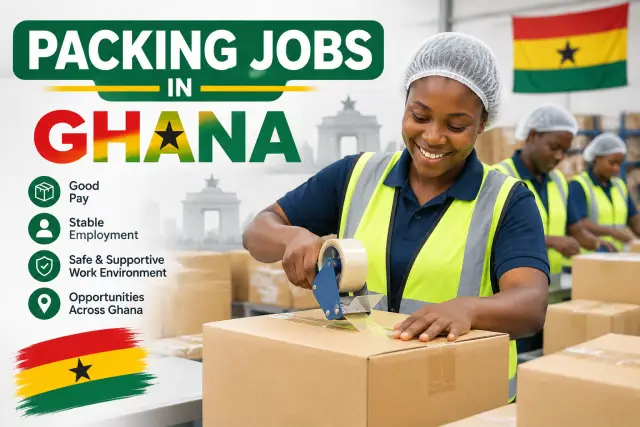
Let's start with something people don't say enough: packing jobs aren't glamorous. But they're real, they're everywhere in Ghana, and for a lot of people they're the first proper paycheck they ever get.
So if you're searching for one right now, here's what I've picked up about how it works, where to look, and what to watch out for.
What does a packer actually do?
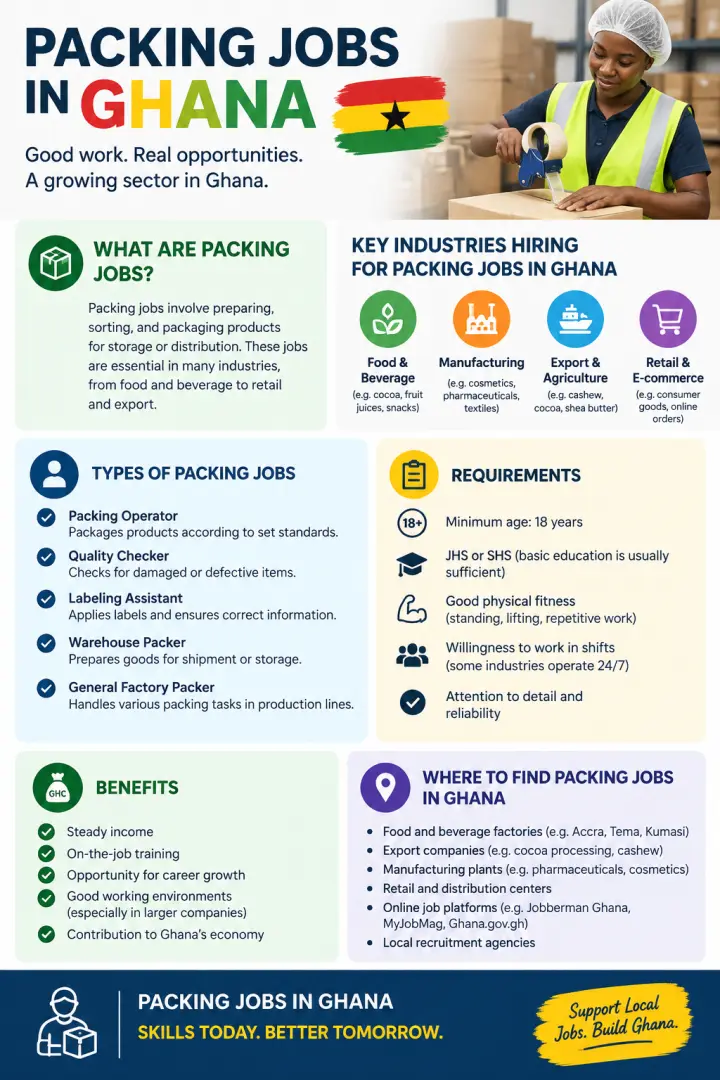
Pretty much what it sounds like. You take products and put them in boxes, bags, bottles, crates or cartons. Then you seal them, label them, and stack them so they can be shipped out.
Sounds simple. It is, mostly. But the day-to-day changes a lot depending on where you land.
- In a factory, you might stand at a conveyor belt for hours, checking and bagging items as they pass.
- In a warehouse, you're picking orders, wrapping goods, and loading trucks.
- At a supermarket or a distribution company, you could be sorting stock and packing customer orders.
- In food and drinks companies, it's about hygiene, speed, and counting properly.
Some jobs are light. Others? You'll be lifting heavy cartons all day. Ask about this before you say yes.
Where the jobs actually are
Location matters more than people think. You won't find many packing roles in a small village, but near industrial areas they pop up all the time.
Accra and Tema
This is the big one. Tema has the port, the free zone, and a long list of factories. Think food processing, beverages, plastics, cosmetics and household goods. Spintex Road and the Accra industrial area have loads of warehouses too.
Kumasi
Plenty going on here as well, especially in the trading and distribution side. Wholesale companies need people to pack and move goods daily. Ahafo and Ashanti also have agro-processing companies hiring packers when production picks up.
Takoradi and other places
Takoradi has the port and the cocoa and timber business. Tamale and some other northern towns have shea and grain processing, where packing work shows up seasonally.
Seasonal, by the way, is a big word in this field. A company might hire 30 extra hands before Christmas and let most of them go in January. Not fun, but useful to know.
How much do packers earn in Ghana?
Honestly, it depends. And I'd be lying if I gave you one neat number.
The national daily minimum wage is a bit under GH₵20 as of the last update I saw, and it's reviewed every year, so check the latest figure. Many packing jobs pay a little above that, especially in bigger companies. From what I've seen, monthly pay for entry-level packers often lands somewhere in the GH₵800 to GH₵1,500 range. Some pay less. A few pay more, particularly if you work nights or take overtime.
Smaller shops and informal setups can go lower. That's just how it is.
Things that can push your pay up:
- Night shifts and weekend work
- Overtime during busy months
- Being fast and accurate (supervisors notice)
- Moving up to a checker, line leader or stock controller role
What you need to get hired
Less than you'd think. Most packing jobs don't ask for a degree. Some want you to have finished JHS or SHS, and that's about it.
But you'll still need to look organised. Bring:
- Your Ghana Card (more and more employers ask for this first)
- A simple CV, one page is fine
- Passport pictures
- Copies of your certificates, if you have any
- A medical or health certificate, if it's a food or drinks company
Food companies are strict about hygiene. Clean nails, hair covered, no jewellery on the line. It sounds picky until you've seen how much product gets rejected over small mistakes.
The skills that get you noticed
Nobody expects fancy skills. What they want is someone who shows up on time and doesn't make a mess of the count.
Being fast helps. Being careful helps more. A packer who sends out 50 wrong boxes costs the company real money, so employers value accuracy over speed once you get past the first week or two.
Basic reading and counting matter too. You'll be checking labels, batch numbers, and quantities. A bit of English goes a long way here, even if you speak Twi, Ga or Ewe on the floor all day.
And stamina. Not gonna lie, standing for eight hours is tiring. Wear comfortable shoes. Seriously.
How to find openings without wasting weeks
Here's the thing. Most people only check one place and give up. Don't do that. Try a few at once.
Online job boards
Jobberman Ghana, LinkedIn, and a few local job sites list warehouse and production roles regularly. Search words like packer, warehouse assistant, production operator, and packaging assistant. Different companies use different titles for the same work.
Facebook and WhatsApp groups
Plenty of local hiring happens here. Join Ghana job groups, but be picky about what you trust (more on that below).
Just walk in
Old school, but it works. Go to the industrial areas, find the factory gate, ask for the HR or security desk, and leave your CV. Some companies hire quietly through walk-ins and never post anything online. I know people who got started exactly this way.
Ask around
Friends, family, church members, former classmates. A referral gets your CV read faster than almost anything else. People hate hearing it, but it's true.
Watch out for scams
Okay, real talk. This part matters.
Fake job posts are all over social media. Packing jobs are an easy cover because everybody knows they exist and few people ask hard questions.
Red flags:
- They ask you to pay a registration fee, interview fee or uniform fee before you start
- The recruiter only talks on WhatsApp and won't give a real office address
- The salary sounds too good for entry-level work
- The offer is for packing jobs abroad, in Canada, the UK or the Gulf, with a fee for the visa or placement
That last one catches a lot of people. Some overseas offers are real, but plenty aren't. Check with the Ghana Labour Department or the company's official site before you send a single cedi.
A real employer doesn't charge you to work for them. Simple as that.
Making it through the first month
The first few weeks are the roughest. Your back hurts, your feet hurt, and the supervisor seems to be looking only at you.
Stick with it. Ask questions early instead of guessing. Learn the product codes, the packing order, and what a rejected batch looks like. Most people who stay past month one find it gets easier, and quickly.
Also, check your contract. Is it permanent, contract, or casual? Are SSNIT contributions being paid? Is overtime paid separately? These things feel awkward to ask about, but they're your right to know.
Is it worth it long term?
Depends what you want. As a stepping stone, yes, absolutely. You learn how a production line works, how a warehouse runs, and how to follow a schedule. Those skills carry over.
Some packers become team leads. Others move into inventory, quality control, or logistics. I've seen a guy start at a bottling plant in Tema and end up running the dispatch desk a few years later. He didn't have a degree. He just kept turning up and learning.
Is it the dream job? Probably not for most people. But it pays, it's available, and it gets you started. For someone looking for steady work in Ghana right now, that counts for a lot.
So update that CV, charge your phone, and start applying. Today, not next week.