


Ask anyone in Accra how they got to work this morning and there's a driver somewhere in the story. Trotro, Bolt, a company bus, a cousin's car. Ghana runs on wheels, and that means driver jobs aren't going anywhere.
But not all of them are the same. Not even close.
The main types of driver jobs you'll actually find
Let's start with what's out there, because a lot of people only think of taxi or trotro and stop.
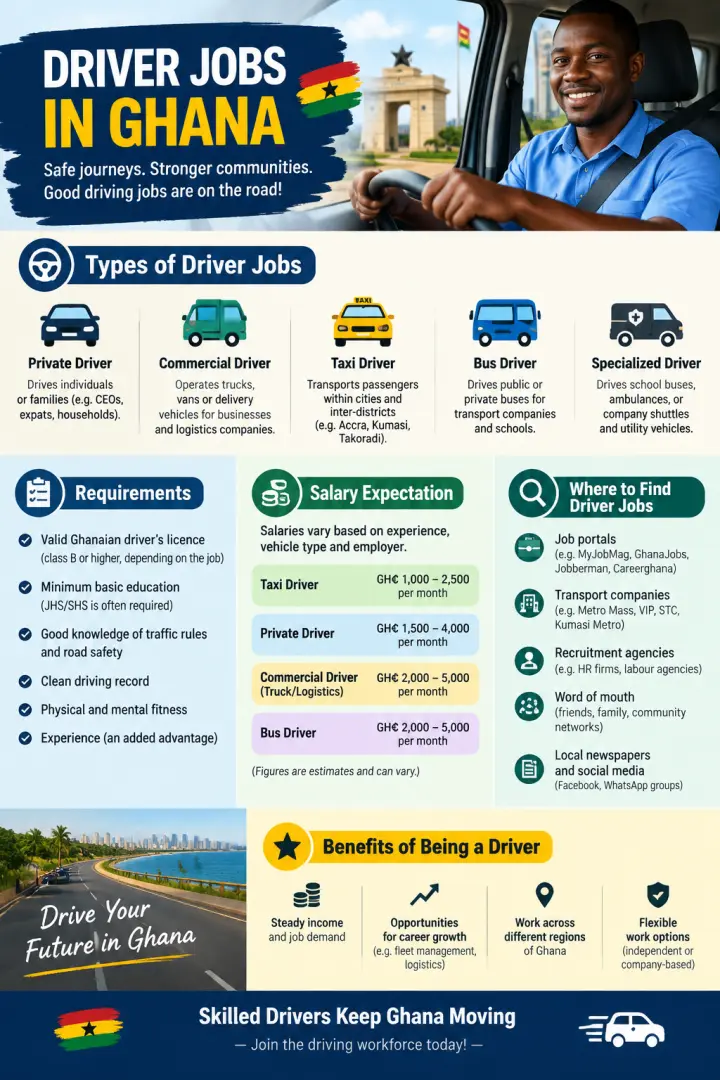
- Private driver or chauffeur. You drive one family or one boss. Steady hours (mostly), steady pay, and you get to know the person well.
- Ride-hailing. Uber, Bolt, Yango. You either own the car or you drive someone else's.
- Company driver. Banks, NGOs, mining firms, hotels, supermarkets. They need staff drivers for runs, deliveries and executives.
- Truck and haulage. Tema and Takoradi ports, long trips up north, sometimes across the border to Burkina Faso or Mali.
- Bus drivers. School buses, staff buses, intercity coaches like the ones leaving Kumasi and Tamale every day.
- Delivery riders. Motorbikes mostly. Food apps, courier firms, pharmacies.
- Tanker and special vehicles. Fuel, water, cement mixers. Harder work, usually better money.
Pick based on your license first, then your lifestyle. Not the other way round.
Your license decides almost everything
Real talk: a lot of people apply for jobs they don't qualify for and wonder why nobody calls back.
In Ghana, the DVLA issues licenses by category. Regular private cars sit in one category. Heavier trucks, buses and articulated vehicles need a higher one. Motorbikes have their own. If you want to drive a trailer out of Tema, a basic car license won't cut it, and employers will check.
You'll also want your license to be valid and clean. No fake papers. Employers ring the DVLA or ask a mechanic friend, and word moves fast in this business.
Also worth sorting before you apply:
- Valid ID (Ghana Card makes everything easier these days)
- Two passport photos, just in case
- A recent medical report, especially for company or bus jobs
- Police clearance if you're going for a private or corporate role
- A guarantor or referee who'll actually pick up the phone
That last one matters more than you think.
So what does it pay?
Honestly, it swings a lot. I won't pretend there's one number, because there isn't. Pay depends on the city, the employer, the vehicle and how many hours they expect from you.
From what I've seen, private drivers in Accra can land somewhere around the lower-to-mid thousands of cedis a month if they're working for a well-off family or executive, and less in smaller towns. Company drivers usually get a fixed salary plus maybe allowances for overtime or fuel runs. Truck drivers often earn per trip on top of a base, so a busy month looks very different from a slow one.
Ride-hailing is its own animal. Some drivers do well. Others work 12 hours and go home with almost nothing after fuel, the car owner's share, and the platform's cut. Do the math before you sign anything.
Quick thought on 'work and pay'. It's common here. You rent or lease a car and pay the owner a set amount weekly. Sounds fair. And it can be, but read the terms. Who pays for repairs? What happens if the car breaks down for a week? Get it in writing, even if it's just a WhatsApp message both of you agree to.
Where do you even look?
Not on one site. That's the first mistake.
Job boards like Jobberman Ghana and Indeed do list driver roles, mostly corporate ones. Check them once or twice a week, not once a year. Facebook groups and WhatsApp communities for drivers are often faster, and lots of private families post there because they trust word of mouth over ads.
Then there's the old-school way. Walk into a company with your documents. Seriously. Hotels, logistics yards, transport firms around Tema, Kaneshie, Kumasi Suame. Ask for the transport or admin manager. Some of the best drivers I know got hired because they showed up neatly dressed and said, 'I'm a driver, here's my license, do you need anyone?'
And tell people. Your pastor, your mechanic, your old boss. Referrals still beat everything.
A quick word on scams
If someone asks you to pay money to get a driver job, walk away. Registration fee, 'uniform fee', 'processing fee'. Nope. Real employers don't charge you to work for them.
Same with anyone promising a job abroad as a driver who wants cash upfront. Be careful, please.
Getting hired when you've got no formal experience
Maybe you've driven your uncle's car for years but never held an official job. That's fine. It counts, just not on paper.
Here's what I'd do. Get a reference from someone who's seen you drive. Learn the basics of the vehicle, like checking oil, tyres and brakes before a trip. Know the roads in your city without relying fully on Google Maps. And practice a short, honest answer to 'tell me about your driving experience.'
Employers want to feel safe handing you keys. That's really it.
Some will give you a test drive. Stay calm, drive like you'd drive their child. Don't show off. Indicate, check mirrors, no sudden braking. They're watching habits more than speed.
Skills that make you stand out
Being on time. Sounds basic. It's the number one complaint bosses have about drivers.
Beyond that, a few things push your name to the top of the pile:
- Good English plus at least one or two local languages. Twi, Ga, Ewe, Hausa, depends on where you work.
- Basic mechanical know-how, so a small problem doesn't turn into a big bill.
- Honesty with fuel and trip records. Bosses notice quickly when numbers don't add up.
- Staying calm in traffic. Accra on a Friday evening will test anyone.
- Smartphone skills, because even small firms use WhatsApp for dispatch and apps for tracking.
Defensive driving training helps too. Some employers and insurance companies like seeing it, especially for bus and truck roles.
The tough side nobody puts in the job ad
Long hours. Police stops. Bad roads, especially in the rainy season. Cargo delays at the port that eat your whole day. Fuel price jumps that squeeze ride-hailing earnings overnight.
It's a real job with real stress. I'm not saying that to scare you off, just so you go in with open eyes.
Your health matters here. Sitting twelve hours wrecks your back, and sleeping badly puts you and others at risk. Take breaks. Drink water. Don't push through when you're falling asleep at the wheel (I've seen what that looks like on the Accra-Kumasi highway, and it's not pretty).
Is it worth it long term?
Depends what you do with it.
Some drivers stay drivers forever and do fine. Others use the job as a stepping stone. They save, buy a car, start their own ride-hailing side, or move into fleet supervision, dispatch or logistics management. A driver with a good name and a cool head gets noticed.
Think about where you want to be in three years. Then pick the job that gets you closer, even if the pay today is slightly lower.
Where to start this week
Check your license date. Fix any paperwork gaps. Write down three people who'd vouch for you. Then apply to five places, not one.
Simple. Not easy, but simple.
And if the first month doesn't bring a call, keep going. Driver demand in Ghana is steady, and the people who keep showing up, on time and with clean papers, are the ones who end up behind the wheel.