

A category B licence can open the door to plenty of driver jobs in France, from delivering parcels around Lille to bringing groceries to customers in Lyon. Want to drive a heavy truck or a bus? That’s a different route, with extra licences and training to sort out first.
French helps, too. You don’t always need perfect grammar, but you’ll often need to understand delivery instructions, safety rules and a customer who’s calling because you’re at the wrong entrance (it happens).
What kind of driver jobs can you find?
Start with the vehicle you’re allowed to drive and the hours you can actually work. A local van route and a cross-border lorry job can feel like completely different careers.
Delivery driver and courier jobs
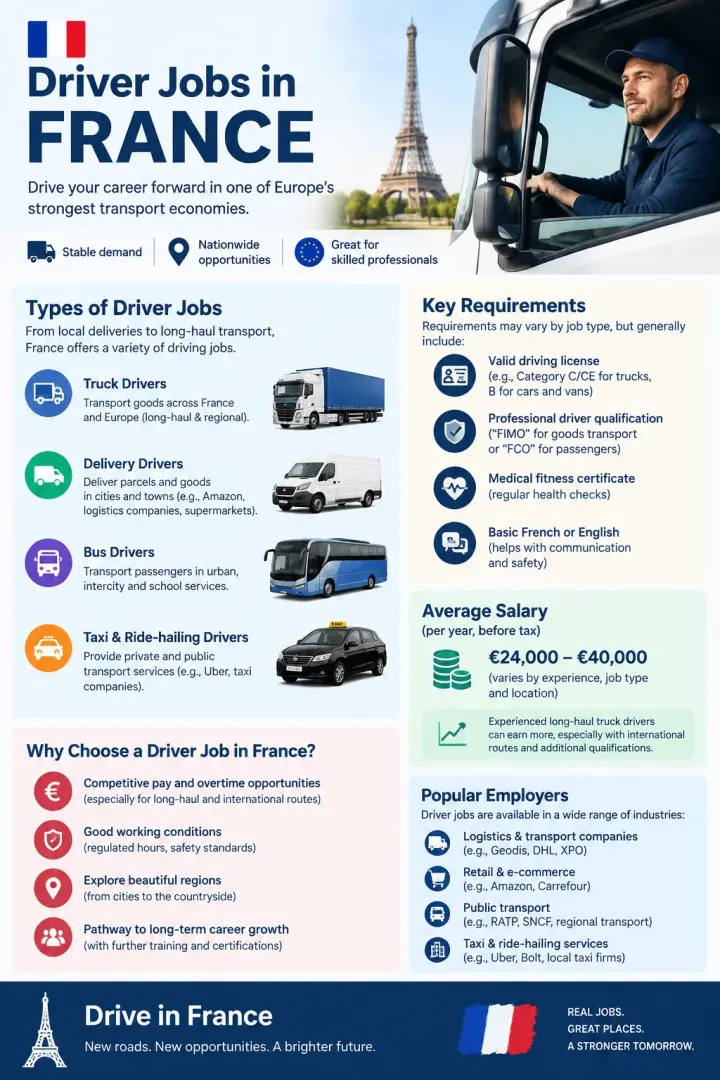
Parcel companies, supermarkets, restaurants and local businesses hire delivery drivers across France. Job ads often use the terms chauffeur-livreur or livreur, though the vehicle and contract can vary quite a bit.
Many van jobs ask for a valid category B licence. Expect early starts, lifting parcels, using a delivery app and dealing with parking in places where parking seems to be a rumour. Some employers provide the van; others advertise work for independent drivers who need their own vehicle.
Look closely at the hours. A job described as a simple local route might still include Saturdays, tight delivery windows or a lot of walking up stairs.
Truck and HGV driver jobs
Search for chauffeur poids lourd, usually shortened to chauffeur PL, or chauffeur super poids lourd for larger combinations. These jobs can involve supermarket deliveries, construction materials, refrigerated goods or long-distance freight.
In general, you’ll need a category C licence for a heavy truck, or CE for certain truck-and-trailer combinations. Professional drivers may also need initial training called FIMO and regular refresher training called FCO, depending on the work and any exemptions that apply.
And there’s more than driving involved. You might check loads, handle delivery paperwork, use a digital tachograph and spend nights away from home. Ask about the route before you say yes.
Bus and coach driving
Look for conducteur de bus or conducteur de car if you’d rather carry passengers. City buses, school transport, airport shuttles and tourist coaches all need drivers, but the schedules aren’t alike.
A category D licence is generally needed for larger passenger vehicles, along with professional training where required. Some employers recruit people without the licence and help pay for training. That can be a useful way in — just check whether the contract ties you to the company for a set period.
Taxi and private-hire driving
Taxi and VTC jobs are separate in France. VTC stands for voiture de transport avec chauffeur, and it covers pre-booked private-hire journeys. A taxi can work under different rules, including taking passengers from taxi ranks or being hailed where permitted.
Both routes involve more than having a car and a driving licence. Expect professional requirements such as an exam, a medical check and a professional card, with specific rules depending on the job. Taxi drivers also need access to a taxi operating licence, known as an autorisation de stationnement or ADS.
Thinking about app-based work? Check the costs before getting excited by a daily earnings figure. Vehicle payments, insurance, fuel, platform fees and social contributions can take a serious bite.
Can you use your current driving licence in France?
That depends on where it was issued, how long you’re staying and whether it covers the vehicle in the job ad.
A valid EU or EEA driving licence is generally recognised in France, subject to the usual conditions. A licence from outside the EU or EEA may be usable for a limited period after you become normally resident, but the rules depend on your situation. You may need an official translation, and exchanging the licence for a French one is only possible when the relevant conditions are met.
Don’t assume every foreign licence can be exchanged. Check the current rules for your issuing country on Service-Public.fr before paying for training or accepting a job. The French authorities can also explain what applies if you’re moving from the UK.
For a truck or bus role, ask the recruiter to confirm whether your professional licence categories and driver training are recognised. A licence that lets you drive a car won’t automatically cover paid HGV or passenger work.
Do you need a visa or work permit?
EU, EEA and Swiss citizens can generally work in France without a separate work permit. If you’re from outside those groups, you’ll usually need the right immigration status to work, and an employer may need to obtain a work authorisation before you start.
There isn’t one visa for every driver. Your nationality, residence status, contract and length of stay all matter. Start with France-Visas and the French administration’s guidance, then ask the employer who’s handling the work-authorisation application.
A genuine employer should be clear about the contract and process. Be wary if someone promises a guaranteed visa, asks for a large upfront recruitment fee or wants your passport before you’ve verified who they are. Not great.
What do driver jobs in France pay?
Pay varies by region, vehicle, experience and working hours. As a rough guide, many full-time delivery and truck-driving ads offer a monthly gross base salary somewhere around €1,800 to €2,600, though offers can fall outside that range. Specialist work, nights, overtime and long-distance routes may pay more.
Those figures are a starting point, not a promise. French job ads often show brut, meaning gross pay before employee deductions. The amount you receive is net. Ask whether the advertised figure includes bonuses, overtime or expense allowances, and check the applicable minimum wage and collective agreement.
For a long-haul job, a higher monthly figure may include time away, meal allowances or unusual hours. For independent work, turnover isn’t take-home pay. Big difference.
Questions to ask before accepting
- Is the salary gross or net, and how many hours does it cover?
- Are overtime, night work and Sundays paid separately?
- Who pays for meals, accommodation and tolls on longer routes?
- Is the vehicle supplied, and who covers fuel, maintenance and insurance?
- Is it an employee contract or self-employed work?
- Will the employer pay for any required training?
Where should you look for work?
France Travail is a good place to start for vacancies and employment support. EURES can also be useful if you’re looking across European borders. Indeed and HelloWork carry driver ads, while transport companies, supermarkets and local bus operators often post jobs on their own websites.
Try a few French search terms instead of only typing “driver jobs in France”:
- chauffeur-livreur permis B — delivery driver with a category B licence
- conducteur routier PL — heavy truck driver
- chauffeur SPL — driver of larger truck-and-trailer combinations
- conducteur de bus formation — bus driver roles that may include training
- chauffeur VTC salarié — employed private-hire driver
Add a city or department to narrow the results. Lille and its surrounding area have cross-border freight activity; Lyon is a major transport hub; and Paris has plenty of delivery and passenger work. But don’t overlook smaller towns, where a local depot or school transport company might be hiring.
Some ads use débutant accepté, meaning beginners are welcome. Others ask for expérience exigée, so experience is required. A CDI is an open-ended contract, while a CDD has a fixed term. You’ll also see temporary agency work called intérim.
Getting your application ready
Keep your CV clear and easy to scan. List your licence categories, any professional driver training, the types of vehicles you’ve used and whether you’ve driven locally, nationally or across borders. If you’ve handled refrigerated goods or passenger transport, say so.
A short French CV can help, even when the advert is in English. You don’t need to pretend your French is better than it is — give an honest level and mention other languages you speak. For customer-facing routes, that can be useful.
Have copies of your licence, relevant certificates and proof of your right to work ready. Share personal documents through a trusted channel once you’ve checked the employer and understand why they need them.
A quick word on hours and safety
Driving time isn’t the same as the whole working day. Loading, waiting and paperwork can add hours, so ask what a typical shift looks like rather than relying on the route distance alone.
For many HGV and coach journeys covered by EU drivers’ hours rules, a driver must take a 45-minute break after no more than 4.5 hours of driving, with certain split-break options. Daily and weekly driving limits and rest rules also apply, though there are exceptions for some work. The employer should explain which rules cover your route and how to record your time.
And if the schedule looks impossible without skipping breaks? Ask about it before signing. A decent job should let you do the work safely.
Ready to start looking?
Pick a role that matches your licence first, then check the training and work-permit requirements for your situation. Search in French as well as English, compare a few real job ads and ask what’s included in the pay.
One practical step: search chauffeur-livreur permis B or conducteur routier PL with the name of the town where you want to live. You’ll get a much better picture of local hours and wages than a national average can give you.