
What kind of driver job are you looking for?
Driving jobs in Switzerland cover a lot more than long-haul trucking. You might be delivering parcels around Zürich, driving a bus in Geneva, moving building materials near Bern, or taking hotel guests to and from an airport.
The licence you need, the hours you’ll work and the language expected on the job can be completely different. A category B licence may be enough for some van jobs. For a heavy truck or a bus, there’s more paperwork and training involved.
And location matters. A route through city traffic isn’t much like an early-morning delivery run through mountain villages in winter.
Driver jobs you’ll come across in Switzerland
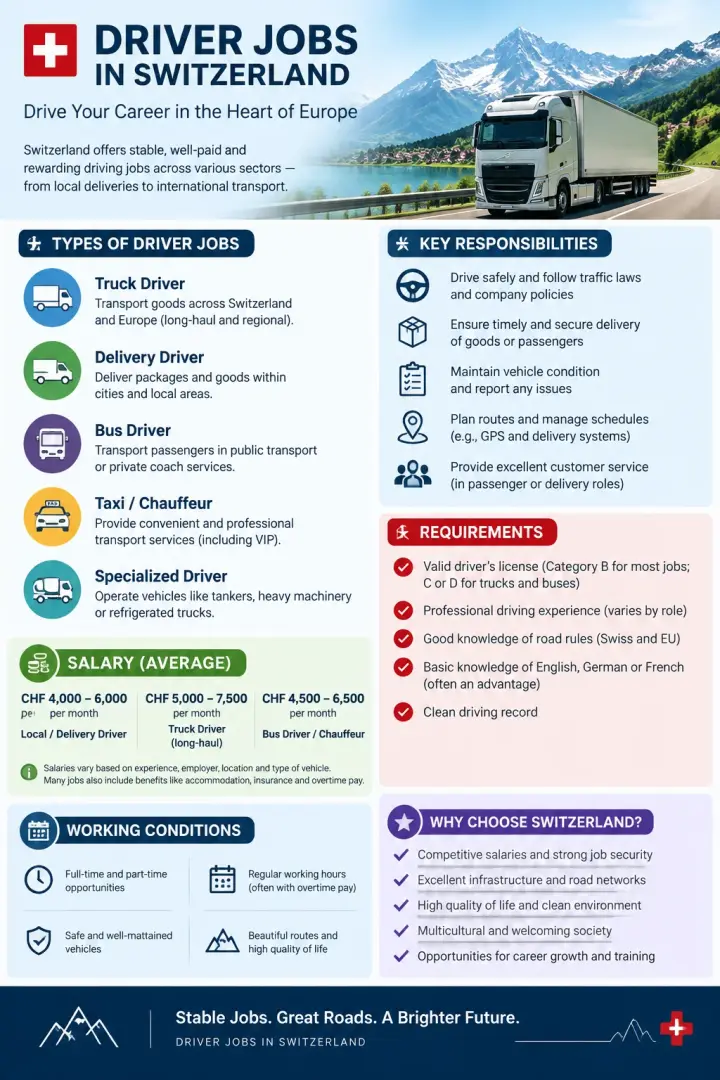
Delivery van and parcel driver
These jobs often involve loading a van, following a delivery route and handing over packages. Some roles include collecting returns or dealing with customers at the door. Expect plenty of getting in and out of the vehicle, not just sitting behind the wheel.
A standard category B licence is commonly requested for lighter vans, though the vehicle’s weight and the work involved can change the requirements. Check the job ad rather than assuming every van can be driven on the same licence.
Hours vary. Some delivery jobs start early, and parcel companies may need extra staff around busy shopping periods. Local language skills can help when an address is wrong or nobody answers the bell.
Truck and heavy goods vehicle driver
Truck drivers move everything from supermarket stock to construction materials. You’ll find local routes where you’re home each evening, plus longer routes that cross borders or involve nights away.
Depending on the vehicle, you’ll usually need category C or C1, with an additional trailer category such as CE or C1E where required. Professional goods transport can also require a valid certificate of professional competence under Swiss rules, often referred to as CZV or OACP. Some exceptions apply, so check the exact role with the employer and the cantonal road traffic office.
Ask what the job actually includes. A building materials driver might use a crane or unload at a site; a refrigerated delivery driver may have several stops before most people have had breakfast. Those are pretty different working days.
Bus, coach and passenger transport
Public transport companies hire bus drivers for city and regional routes. There are also coach jobs, school transport roles and seasonal work with hotels or tour operators.
Bus and coach roles usually call for category D or D1, depending on the vehicle, along with professional qualifications where required. Employers may offer training for some positions, but don’t assume the cost is covered. Ask whether there’s a repayment agreement if you leave early.
Passenger-facing work usually means more language contact than a warehouse delivery job. You might need to answer questions, handle unexpected route changes or help someone with a ticket. Split shifts and weekend work are common things to ask about too.
Taxi, private hire and chauffeur work
Driving a taxi or a paid passenger vehicle can involve extra permits beyond a regular category B licence. Switzerland has specific rules for professional passenger transport, and local taxi rules can differ by canton or municipality.
Before applying, check whether the position requires the Swiss professional passenger transport authorisation, sometimes shown as code 121, as well as any local taxi permit. A hotel chauffeur job and a taxi job won’t necessarily have identical requirements.
Other driving roles to keep an eye on
Not every opportunity has “driver” in the title. Look for food distribution, medical deliveries, vehicle recovery, waste collection and construction transport. Some employers want warehouse help as well — loading pallets at 6 a.m., then heading out on the route.
Courier and food delivery work may also be advertised as self-employed. Read the terms carefully: providing your own vehicle, fuel and insurance can change what you actually earn.
Can you work in Switzerland?
Here’s the part to sort out before spending hours sending applications. Having a driving licence doesn’t automatically give you the right to work in Switzerland.
If you’re a citizen of an EU or EFTA country, you can generally work in Switzerland under free movement rules, but you’ll still need to follow the right registration or permit process. For a job lasting more than three months, you’ll generally register with your local municipality within 14 days of arrival and before starting work. Shorter employment can fall under a notification procedure.
For non-EU/EFTA nationals, getting permission is generally more restrictive. Swiss employers usually need to apply for a permit, and the rules often favour highly qualified workers. That can make sponsorship for ordinary driving jobs difficult. There are exceptions and individual circumstances, though, so check with the employer and the relevant cantonal migration office.
Living across the border and commuting into Switzerland is another option for some workers. Cross-border permits have their own conditions, which depend partly on nationality and residence. Don’t assume you qualify just because you live in France, Germany or Italy.
Will your foreign driving licence be accepted?
Switzerland generally allows new residents to use a valid foreign driving licence for the first 12 months after taking up residence. After that, you’ll normally need a Swiss licence to keep driving. Depending on where your licence was issued and the categories you hold, the exchange process may include further checks or a driving test.
But professional driving can have stricter timing. In some cases, you’ll need to exchange or obtain the appropriate Swiss licence before you start driving professionally, rather than waiting for the end of that first year. Check with the road traffic office in the canton where you’ll live.
The same goes for professional qualifications. An EU driver qualification or code 95 may be relevant to a Swiss employer, but recognition depends on the document and your circumstances. Ask the cantonal office and the employer what they’ll accept before paying for training or making a move.
Useful documents to have ready include your current licence, proof of professional training, a driver card if the job needs one, and any records of previous driving work. Some employers may also ask for a criminal record extract or a medical assessment.
How much do drivers earn in Switzerland?
Swiss salaries are usually quoted in Swiss francs, or CHF, and often as a gross monthly or annual amount. That’s before deductions for social insurance and other items. The figure in your account will be lower.
There isn’t one reliable salary for every driver job. Pay changes with the canton, company, vehicle category, experience and schedule. A full-time bus driver with shift allowances won’t necessarily earn the same as a delivery driver working regular daytime hours. And some employers pay a 13th monthly salary, so ask whether the advertised amount includes it.
For a useful comparison, check several current ads in the same area and use the Swiss government’s Salarium wage calculator if a suitable occupation is available. Your canton may also publish wage information. Look at the full package, not just the biggest number on the page.
- Is the salary gross or net, and is a 13th payment included?
- Are night, Sunday or overtime hours paid extra?
- How many hours make up a normal working week?
- Who pays for required training, medical checks and licence updates?
- Are meals, overnight stays or travel costs covered?
Cost of living deserves a look too. Rent around Zürich or Geneva can take a serious bite out of a pay packet, while commuting from farther away adds time and transport costs. A shared flat, a parking space and a motorway commute can make the maths look very different.
Do you need German, French or Italian?
Often, yes — at least some. The useful language depends on where you’ll work: German is widely used across much of Switzerland, French in the west and Italian in Ticino. You may also hear Swiss German at work, even when written instructions are in standard German.
English-only jobs exist, particularly with international businesses or some private clients. But they’re a smaller pool. For most local routes, being able to understand safety instructions, speak with dispatch and deal with customers gives you a better shot.
Look at the ad for the level requested. If your German is basic but improving, say so honestly on your CV. Claiming fluency and then struggling with a safety briefing? Not a great start.
Where to find driver jobs in Switzerland
Start with the Swiss public employment service at Job-Room, then check general job boards such as jobs.ch and JobScout24. Company career pages are useful too, especially for transport operators, logistics firms, supermarkets and local bus companies.
Search in the local language as well as English. You’ll find more listings, even if you need a translation tool to understand the first pass.
- German: “Chauffeur”, “Lastwagenfahrer”, “Lieferfahrer” or “Busfahrer”
- French: “chauffeur poids lourd”, “livreur” or “conducteur de bus”
- Italian: “autista”, “autista camion” or “corriere”
- Try adding a city, canton or licence category, such as “Chauffeur CE Zürich”
Recruitment agencies can be useful for temporary logistics work, though you should still check the contract and hourly pay yourself. And if a listing says you’ll need a car to reach a depot outside town, take that seriously. An early shift can start before public transport is running.
Make your application easy to scan
Put your driving categories near the top of your CV. Include the country that issued your licence, any professional certificates, languages and relevant experience. If you’ve driven refrigerated vehicles, handled tail lifts or worked with dangerous goods, say so clearly.
Keep the dates straightforward. Employers will want to know whether your experience is recent and what kind of vehicles you’ve actually driven. A short note explaining your work authorisation or permit status can save everyone time.
For an English-language vacancy, an English CV is usually a sensible starting point. If the advert is in French or German, applying in that language may help — provided the information is accurate. Get a fluent speaker to check it if you can.
Before you say yes to an offer
Get the main terms in writing: pay, hours, work location, notice period and any training costs. For professional driving, ask how driving time, breaks and rest periods are recorded. The employer should be able to explain which rules apply to the role.
Watch for anyone asking you to pay upfront for a guaranteed job or work permit. A real employer can explain the hiring process and give you a contract; a stranger pushing you to send money quickly is a reason to step back.
And check the route to the depot before accepting. It sounds small, but a 5 a.m. start, no bus connection and an expensive parking spot can turn a promising job into a tiring one fast.