
Got a valid driving licence and don’t mind spending part of your working day on the road? Belgium has more than one kind of driver job to look at. A local parcel route, a supermarket delivery round and a long-distance truck run can feel like completely different careers.
The first thing to check isn’t the van or truck. It’s your licence, your right to work in Belgium and whether the job asks for extra training. Those details can save you a lot of wasted applications.
What driver jobs are available in Belgium?
Delivery work is an obvious place to start. Companies hire drivers to bring parcels, groceries, furniture and other goods to homes or businesses. Some routes stay within one town; others cover a wider area, with lots of stops and a packed schedule.
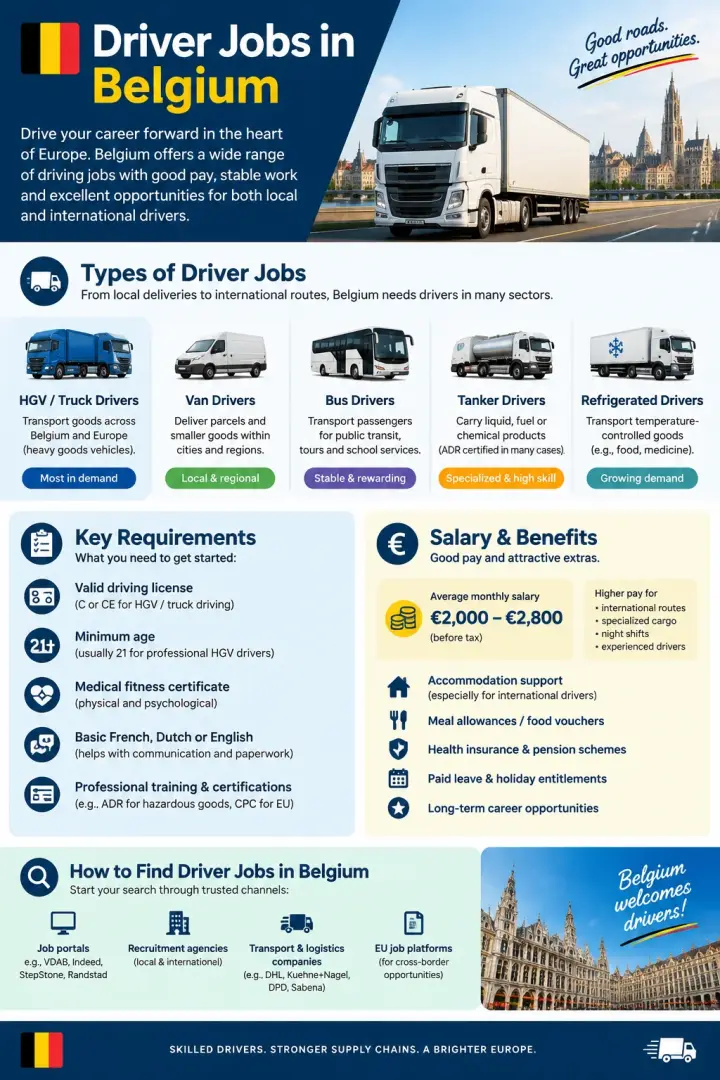
Then there’s truck driving. A local distribution driver might deliver to shops and warehouses during the day, while an international driver could spend several nights away from home. Same broad job title, very different week.
You’ll also see vacancies for bus and coach drivers, chauffeurs, taxi drivers and specialist transport workers. Some employers need people for refrigerated goods, construction materials or tankers. Extra qualifications may apply, so read beyond the job title.
Van and parcel delivery
Many van jobs ask for a category B licence, a clean driving record and enough fitness to carry or move packages. Some involve early starts, weekend shifts or tight delivery windows. And yes, you may spend more time getting in and out of the van than you expect.
Check whether you’re applying for an employee role or work as an independent contractor. That difference matters when it comes to insurance, expenses, paid leave and what you actually take home.
Truck and lorry jobs
Truck vacancies often ask for a category C or CE licence. Local work can include shop deliveries, container transport or trips between distribution centres. International jobs may involve longer distances and overnight stays.
Some roles need experience with a tail lift, loading equipment or particular cargo. Others are open to newly qualified drivers. If a vacancy says experience is preferred rather than required, it may still be worth asking.
Passenger transport
Bus and coach work usually calls for a category D or D1 licence, along with the professional qualifications needed for the role. School runs, city routes, airport transfers and coach tours all have their own schedules.
Taxi and private-hire work is a separate thing. Local or regional rules, permits and driver requirements can apply, so don’t assume a regular car licence is all you’ll need.
Which driving licence do you need?
For many ordinary cars and lighter vans, category B is the starting point. Broadly, it covers vehicles up to 3,500 kg and designed to carry no more than eight passengers besides the driver. Rules and exceptions can depend on the vehicle, so check the actual job and licence requirements.
For heavier goods vehicles, look at category C. Category CE generally covers a category C vehicle with a heavier trailer. Passenger vehicles usually fall under D or D1, depending on their size and use.
Professional truck and bus drivers often need proof of professional competence, commonly shown as Code 95 on the licence or a driver qualification card. Initial qualification and periodic training requirements can apply, though there are exceptions for some kinds of driving.
That little code matters. If you’ve got a C or D licence but aren’t sure whether your professional qualification is current or recognised in Belgium, check before accepting an offer.
What if your licence was issued abroad?
EU and European Economic Area licences are generally recognised in Belgium while they’re valid, although the rules can differ once you live there. For licences issued outside the EU or EEA, recognition and exchange depend on the issuing country and your circumstances. You may need to exchange your licence or take tests.
Ask the Belgian municipality where you’re registered about your licence, and check whether any professional driving qualification you hold is recognised too. A valid licence and valid permission to work are separate matters.
Can foreign workers apply for driver jobs in Belgium?
Yes, but your right to work depends on your nationality and situation. EU and EEA citizens generally don’t need a work permit to work in Belgium. Other nationals may need an employer-sponsored single permit for longer-term employment, or another form of authorisation that fits their circumstances.
Don’t pay someone just because they promise a permit. A genuine employer should be able to explain the hiring process, the contract and who’s responsible for the application. For current rules, check with the relevant Belgian regional employment authority and official immigration services.
Planning to move with a non-EU licence? Check the licence and immigration questions at the same time. Finding an employer who likes your CV won’t automatically make either requirement disappear.
Do you need to speak Dutch or French?
It depends on the route and employer. Dutch is widely used in Flanders, French is common in Wallonia, and Brussels is officially bilingual in French and Dutch. German is also used in Belgium’s German-speaking area.
Some international logistics companies advertise roles in English, especially where drivers deal with warehouses rather than customers. But many delivery, bus and taxi jobs involve speaking with the public. Even basic local-language skills can make a difference when you’re calling a customer or reading site instructions.
Look at the vacancy carefully. If it says Dutch is required, sending an English CV alone probably won’t change that. If the wording’s unclear, ask the recruiter what level they expect.
What do driver jobs in Belgium pay?
Pay varies a lot by vehicle, employer, location, experience and schedule. A delivery van role isn’t necessarily paid like an international CE truck job, and an advertised monthly figure may be gross rather than net.
Before comparing offers, ask for the gross hourly or monthly wage and the expected working hours. Then find out whether the package includes shift premiums, overtime pay, meal vouchers, holiday pay or other benefits. Applicable collective agreements and company rules can affect the details.
For long-distance work, ask how overnight stays, allowances and expenses are handled. For delivery work, find out who pays for fuel, phone use, parking and vehicle damage. Small costs add up.
And if the advert promises a high daily rate for self-employed work, ask what comes out of that amount. Vehicle costs, insurance, tax and social contributions can change the picture quickly.
Where to find driving vacancies
Start with Belgium’s public employment services. They’re useful for searching by region, and some offer training or help with applications:
- VDAB for Flanders.
- Actiris for Brussels.
- Le Forem for Wallonia.
- ADG for Belgium’s German-speaking community.
- EURES for European job listings and information about working across borders.
You can also look directly at the careers pages of transport companies, parcel firms, supermarkets, public transport operators and recruitment agencies. Try searches such as “chauffeur CE”, “chauffeur C”, “delivery driver” or “bus driver”, adding a city like Antwerp, Brussels, Ghent or Liège.
Use local-language terms too. In Dutch, “vrachtwagenchauffeur” can help you find truck roles; in French, try “chauffeur poids lourd”. Search results may include agency listings, so check which company you’d actually work for and where the route starts.
How to put together a useful application
Keep your CV clear. A recruiter should be able to spot your licence categories, professional qualifications and recent driving experience without hunting through a wall of text.
Include the types of vehicles you’ve driven, the areas you know and any relevant skills, such as operating a tail lift or handling delivery paperwork. If you’ve got Code 95, say so and include its validity date. Mention the languages you can use at work, without overstating your level.
New to professional driving? That’s okay. Put your current licence and training near the top, then mention useful experience from other jobs. Customer service, warehouse work and following safety procedures can all be relevant.
Send copies of documents only through a trusted channel, and don’t post your full licence or identity documents publicly. A real vacancy shouldn’t require a payment just to secure an interview.
Questions to ask before you say yes
A job title won’t tell you everything. A quick call can clear up whether the role fits your life (and whether that “local route” really is local).
- Where does the shift start, and is the vehicle kept there?
- How many stops or kilometres are typical?
- Will you load and unload, and is equipment provided?
- Are weekends, nights or overnight stays expected?
- Is the contract permanent, temporary, agency-based or self-employed?
- How are overtime, allowances and expenses paid?
For truck and bus work, ask how driving time and rest breaks are scheduled. EU rules on driving hours, breaks and rest apply to many professional transport operations, though exceptions exist. Some vehicles also require a tachograph. An employer should never expect you to ignore those rules to finish a route.
One more thing — check the commute to the depot. A 5 a.m. start sounds manageable until you realise public transport won’t get you there.
Can you train for a driver job in Belgium?
Yes. Driving schools and training providers offer courses for heavier vehicle licences and professional qualifications. Depending on your situation, a regional employment service may also have training options or support for jobseekers. Availability and eligibility vary, so ask your local service what’s open now.
Some employers recruit people who still need part of their training. Read the terms before signing, especially if the company pays course fees and expects you to stay for a certain period.
If you already hold the right licence, you can start by narrowing the search: local van work or heavy goods, day shifts or nights, employee contract or independent work. That’s usually a better first step than applying to every advert with “driver” in the title.