

What kind of driving job are you looking for?
A driver job in Austria might mean delivering parcels around Vienna, taking tourists to a Salzburg hotel, or spending several days on the road with a truck. Those jobs ask for different licences, schedules, and language skills. So it helps to narrow things down before you start applying.
If you've got a category B licence, local delivery is a practical place to look. Got category C or CE and professional driver training? You'll find a wider range of freight jobs, including routes across Austria and into neighbouring countries.
Driver jobs in Austria: the main options
Delivery and van driver jobs
Parcel companies, supermarkets, restaurants, and local suppliers all use drivers. Some roles involve fixed routes. Others change from day to day, with a van full of packages and a long list of addresses on your phone.
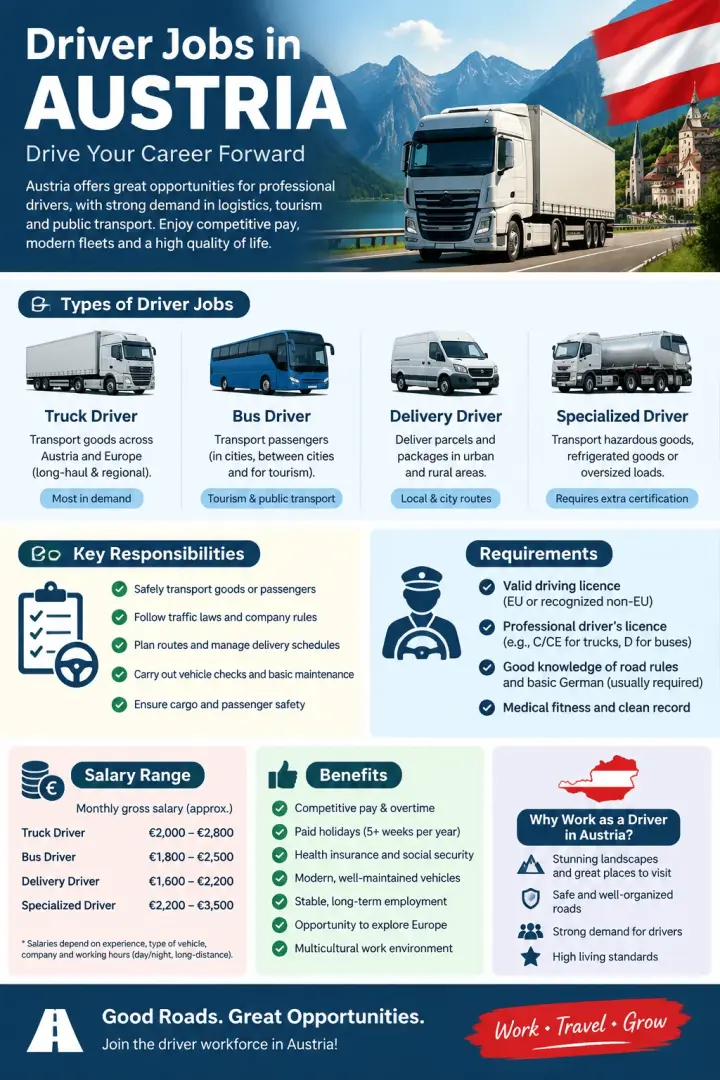
A category B licence covers many standard delivery vans, generally up to 3.5 tonnes. Check the vehicle's permitted weight before accepting a job, though. Bigger vehicles may need a different licence.
Ask how many stops you'll be expected to make, whether you'll load the van yourself, and if the route includes weekends. A job that sounds simple on paper can be pretty physical.
Truck and HGV driver jobs
Austria's location makes it a busy place for road freight. Truck drivers work on local deliveries, warehouse routes, construction sites, and international trips through countries such as Germany and Italy.
For heavier vehicles, employers may ask for category C or CE. Category C covers trucks over 3.5 tonnes, while CE generally allows a category C vehicle with a heavy trailer. You'll often see Code 95 listed too, especially for professional freight work.
Some jobs need extra training, such as an ADR certificate for carrying dangerous goods. Others might want experience with refrigerated loads, loading equipment, or mountain driving. Don't assume every truck role involves long international trips — plenty of drivers are home each evening.
Bus, coach, and shuttle work
Bus driver jobs can include city routes, school transport, airport transfers, and coach trips. Passenger vehicles with more than eight passenger seats generally need a category D licence. Professional bus drivers may also need the right Code 95 qualification, depending on the work.
German can matter more here than it does on some freight routes. You'll be dealing with passengers, announcements, and questions about stops or delays. And a calm manner helps when someone's missed their connection and wants to tell you all about it.
Taxi and private hire
Taxi work has its own rules, so a regular driving licence alone may not be enough. Requirements can include a taxi driver ID, an exam, and proof that you meet local conditions. Check with the relevant authority or a taxi company in the area where you want to work.
Look closely at the contract, too. Are you being hired as an employee, or are you expected to work for yourself? Who pays for the car, insurance, fuel, and platform fees? Those details can make a big difference to what you actually take home.
Which driving licence do you need?
Here's a quick starting point. The exact licence and training requirements depend on the vehicle and the job.
- Category B: cars and many vans up to 3.5 tonnes.
- Category C1: medium-sized trucks over 3.5 tonnes and up to 7.5 tonnes.
- Category C: heavier trucks over 3.5 tonnes.
- Category CE: category C vehicles with a heavy trailer.
- Category D: buses with more than eight passenger seats.
Employers may also ask for a digital tachograph driver card, Code 95, or another job-specific certificate. Code 95 shows that a professional driver has met the relevant qualification and training requirements. There are exceptions, so check what applies to the work you'll actually do.
Got a licence from another country? EU and EEA driving licences are generally recognised in Austria. If your licence was issued outside the EU or EEA and you move your residence to Austria, different rules apply; a foreign licence is generally valid for six months after you establish residence, subject to exceptions. You may need to exchange it or take a driving test.
Before paying for training or accepting an offer, check the current rules for your licence on oesterreich.gv.at or with the Austrian driving licence authority. An employer can tell you what it expects, but it can't make an invalid licence valid.
Can you work in Austria as a foreign driver?
EU, EEA, and Swiss citizens can generally work in Austria without a separate work permit. You'll still need to follow registration rules when you move, and longer stays may involve additional paperwork.
If you're from outside those countries, don't assume that a driving licence or a tourist visa gives you the right to take a job. You may need a residence permit that allows employment, and the route depends on your nationality, qualifications, and the job offer.
Some applicants may qualify for a Red-White-Red Card, but it's not automatic for every driver role. Occupation lists and eligibility rules can change. Check the official Austrian migration website, migration.gv.at, and ask the employer which permit process applies before making plans to relocate.
One practical detail: permission to work and permission to drive are separate things. You'll need both sorted.
Do you need to speak German?
Not always. Some international transport companies use English in parts of their work, and a few delivery jobs may accept applicants with basic German. But more German usually gives you more choice.
Think about the small moments: calling a customer who's not home, reading a delivery instruction, or explaining a delay to a dispatcher. Even basic phrases can make the day less stressful. For bus, taxi, and customer-facing jobs, employers may expect stronger German or set language-related requirements.
Job ads often state a level, so look for terms such as Deutschkenntnisse (German skills). Ask what that means in practice. A warehouse manager may need you to understand safety instructions even if the interview itself is in English.
How much do drivers earn in Austria?
Pay varies a lot by vehicle, region, experience, hours, and employer. A local van route and an international CE job aren't likely to have the same pay structure. Night shifts, weekends, overtime, and travel-related payments can also change the final amount.
Austria doesn't have one general statutory minimum wage for every job. Many employees are covered by a collective agreement, called a Kollektivvertrag, which sets minimum pay and other conditions for a particular sector. Ask which agreement applies and how your experience affects your pay grade.
You'll often see a monthly gross salary in an ad. Gross means before tax and employee social insurance deductions. Many Austrian collective agreements also provide holiday and Christmas payments, often called the 13th and 14th salaries. The amount and conditions depend on the agreement and contract.
For a simple example, €2,400 gross paid 14 times would equal €33,600 gross a year. That's just maths, not a promise about what a driver job pays. Check whether allowances or overtime are included in a quoted figure, and use an Austrian gross-to-net calculator for an estimate of take-home pay.
Questions to ask before you sign
- What's the base gross salary, and which collective agreement applies?
- Are there 13th and 14th payments? How are they calculated?
- How are overtime, night work, Sundays, and public holidays paid?
- Will you get travel allowances, and what costs are they meant to cover?
- Is loading time paid? What about waiting at a warehouse?
- Does the employer provide the vehicle, work clothes, and required equipment?
Get the answers in writing if you can. A good hourly rate isn't quite as attractive if you're regularly doing unpaid loading or paying unexpected vehicle costs.
What are the hours like?
Early starts are common in delivery work. Truck drivers may have overnight trips, while bus and taxi schedules can include split shifts, evenings, or weekends. Ask for an example of a normal working week rather than relying on the phrase “flexible hours.”
For many heavy goods and passenger transport jobs, EU driving-time and rest rules apply. Drivers generally need a break after 4.5 hours of driving, with rules about how that break can be split. There are exceptions and other limits, so check the rules for your vehicle and route.
And driving time isn't necessarily the same as working time. Loading, paperwork, and waiting can be treated differently depending on the circumstances. If an employer can't explain how hours are recorded or tells you to ignore tachograph rules, I'd walk away.
Where to find driver jobs in Austria
Start with AMS eJob-Room, the Austrian public employment service's job portal. EURES is another useful place to search, particularly if you're moving from another European country. You can also check karriere.at, hokify, willhaben jobs, and company career pages.
Search in German as well as English. It opens up more listings:
- Fahrer or Fahrerin — driver
- Zusteller or Paketzusteller — delivery or parcel driver
- LKW-Fahrer — truck driver
- Berufskraftfahrer — professional driver
- Busfahrer — bus driver
- Fahrer Klasse B — category B driver
- CE Fahrer — category CE driver
Try adding a city or region to your search. Vienna has a large market for local deliveries and passenger transport. Around Linz and Graz, you can also look for industrial and logistics routes. Salzburg, Innsbruck, and tourist areas may have shuttle or coach work, sometimes with seasonal peaks.
Rural jobs can be worth a look too — but check how you'll get to the depot for a 5 a.m. start. Public transport might not be running yet.
Getting your application ready
Keep your CV clear and easy to scan. Put your licence categories near the top, along with Code 95, ADR, or other current certificates if you've got them. Mention the types of vehicles you've driven, the countries or routes you know, and whether you've handled deliveries, passengers, or loading.
Include your language level honestly. “Basic German, currently learning” is better than claiming fluency and struggling through a safety briefing. A short German CV can help when applying to a local company, even if you're still learning the language.
Employers may ask for copies of your licence, qualifications, references, and proof that you're allowed to work. Don't send sensitive documents to an unverified contact just because they promise a quick start. Check the company's website and use its official application channel where possible.
Watch out for offers that sound a bit too easy
A genuine offer should explain the employer, location, job duties, pay, and contract. Be cautious if someone asks for a large upfront payment for a guaranteed job, pressures you to transfer money, or won't give you a written offer. The same goes for recruiters who promise a work permit without checking your situation.
Accommodation is another detail to check. If it's offered, ask about the rent, deposit, address, room sharing, and whether the cost will be deducted from your wages. A cheap room far from the depot isn't much help without transport.
Once you've got a serious offer, take your time with the paperwork. Austria's Arbeiterkammer, or Chamber of Labour, provides information for employees about contracts and workplace rights. That's a useful place to start if something in the offer doesn't add up.